Suspect Spotlight™: Roof Rats in North Florida
The attic climber that knows its way around.
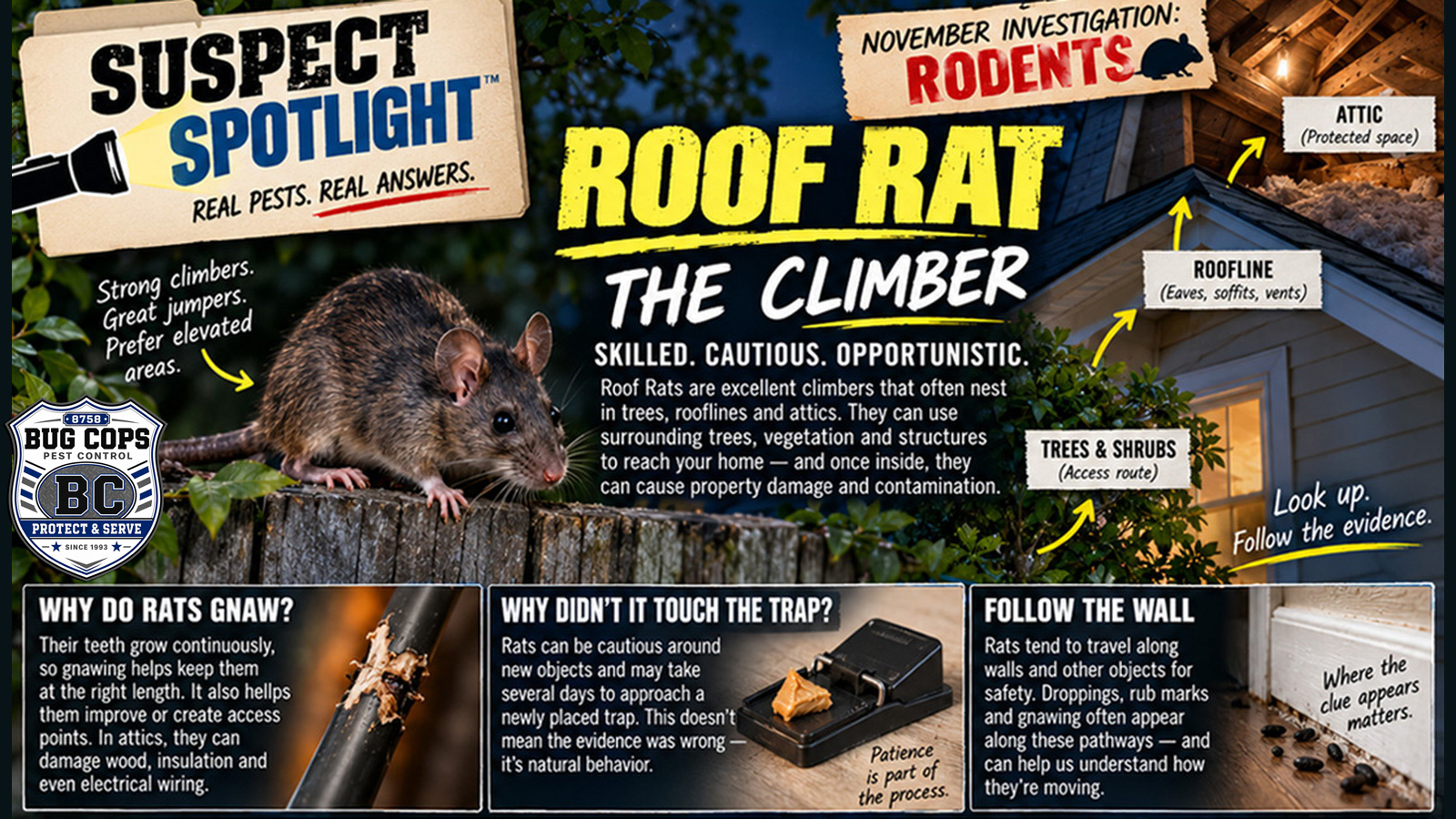
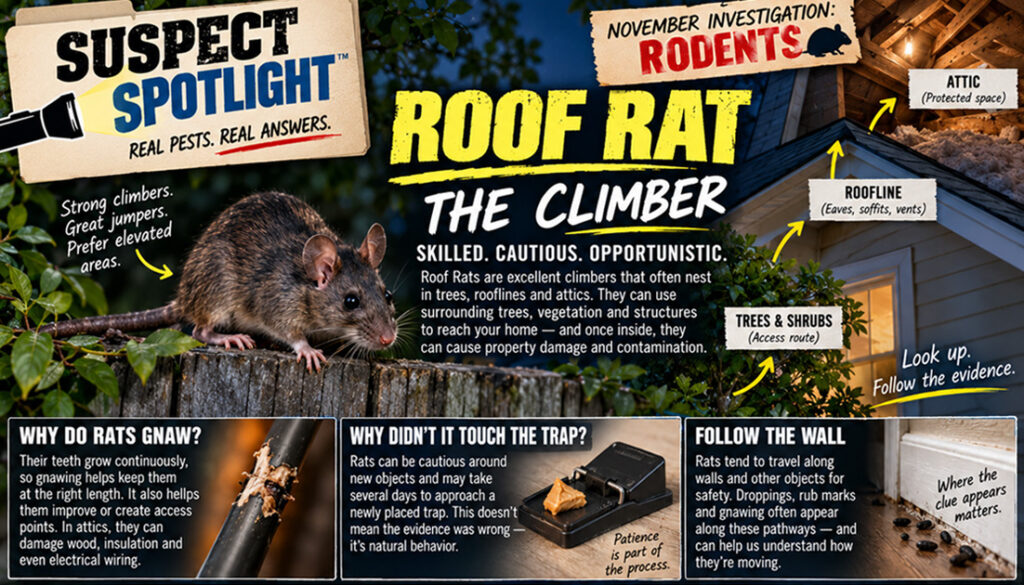
Roof rats in North Florida are skilled climbers. They travel through trees, along fences, and across rooflines.
You hear scratching above the ceiling after dark. Maybe it’s a quick scurry, followed by silence. You check outside, but nothing seems out of place.
Could a roof rat be moving through your attic?
They often stay hidden, leaving homeowners to discover their activity through sounds, droppings, and gnaw marks. For more information, see Signs of Rodent Activity Identification Guide.
And here’s something surprising: An untouched trap doesn’t necessarily mean the rat isn’t there.
Let’s open the case file.
Meet the Suspect: Roof Rat Identification
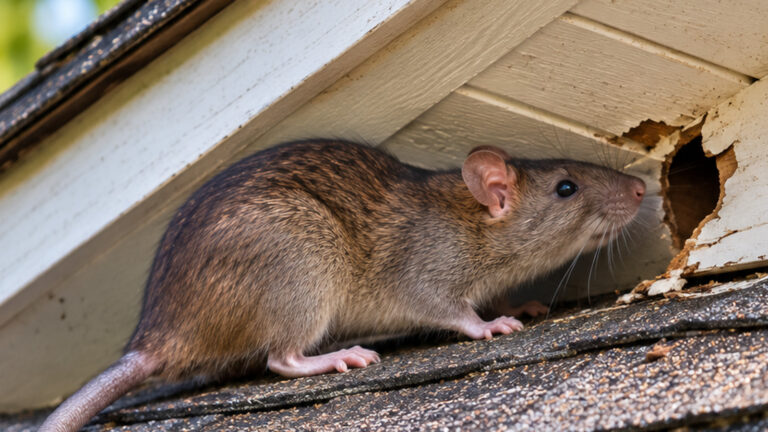
The roof rat (Rattus rattus) is also called the black rat, ship rat, or fruit rat.
Despite the name “black rat,” its fur may be brown, grayish, or nearly black.
Look for these identification clues:
- Body: Slimmer and more streamlined than a Norway rat.
- Face: Pointed muzzle with a relatively narrow head.
- Ears: Large and noticeable compared with its head.
- Tail: Usually longer than its head and body combined.
- Movement: Agile climbing and balancing, especially above ground.
However, appearance alone doesn’t always tell the whole story. Young rats can resemble adult mice, and lighting can make fur colors difficult to judge.
Precinct Note: Roof rats are often identified through a combination of physical features, behavior, and evidence. A single photograph or dropping may not provide enough information for a reliable identification.
Roof Rats in North Florida: Why Look Up?
Roof rats have earned their name.
Unlike Norway rats, which commonly spend time near the ground, roof rats often travel and nest in elevated locations.
In North Florida, that can include:
- Palm trees and dense vegetation
- Tree branches near roofs
- Fences and overhead utility lines
- Attics, soffits, and ceiling spaces
- Storage areas above ground level
Their long tails help with balance as they move along narrow surfaces.
A roof rat may spend time in the landscaping around a home before finding a way inside.
As a result, an inspection shouldn’t focus only on the ground.
How Did It Get Into the Attic?
A roof rat doesn’t need an open door.
These rodents can take advantage of small gaps and damaged areas around a home.
Roof rats can enter through openings near roof edges and damaged soffits. Gaps around utility lines and poorly protected vents may also provide access.
For example, a tree branch touching the roof can also provide an easy route toward the structure.
However, reaching the roof doesn’t automatically mean the rat has entered the attic. There still needs to be an opening.
The important question isn’t only where the rat is hiding. It’s how the rat got inside.
Finding that access point is an important part of preventing repeated problems.
Why Do Roof Rats Gnaw?
Rodents have front teeth called incisors that continue growing throughout their lives.
As a result, gnawing helps keep those teeth worn down.
Unfortunately, roof rats don’t limit their chewing to harmless materials.
They may damage wood, plastic, stored items, and even electrical wiring.
Possible signs include:
- Rough or chewed edges around openings
- Tooth marks on wood or other materials
- Damaged food packaging
- Shredded nesting materials
- Chewed insulation or wiring
Fresh-looking gnaw marks may indicate recent activity, but they don’t identify the rodent species by themselves.
In addition, electrical damage is especially concerning because damaged wiring can create a fire hazard.
Why Didn’t It Touch the Trap?
Here’s our most interesting clue.
The untouched trap doesn’t necessarily mean the rat isn’t there.
Roof rats can be cautious around unfamiliar objects.
Scientists call this behavior neophobia, or avoidance of something new.
Imagine a rat that has traveled the same route through an attic for weeks. It knows where to turn, where to hide, and which obstacles belong there.
Then, suddenly, something unfamiliar appears along its path.
In fact, the rat may avoid it altogether.
Because of this caution, a newly placed trap may remain untouched. However, other signs may still suggest rats are active.
However, an untouched trap isn’t proof of roof rats, either. Placement, competing food sources, and other conditions can affect results.
How Roof Rats in North Florida Travel
Roof rats often use familiar routes as they move between shelter, food, and water.
Along those routes, they may leave evidence that helps reveal their movements.
Look for:
- Droppings near frequently used areas
- Dark rub marks along surfaces
- Tracks in dusty locations
- Gnaw marks near openings
- Disturbed insulation or nesting material
Roof rats may travel along beams, pipes, fences, and other narrow surfaces.
As a result, signs of activity aren’t always found on the floor.
Finding several clues along the same route can help identify where rodents are moving.
Still, avoid entering unsafe attic spaces or disturbing suspected contaminated materials.
THE CASE FILE CLUE: A rat’s behavior can be just as important as the evidence it leaves behind.
What’s the Real Health Concern?
Roof rats aren’t just a nuisance.
Rodents can contaminate food and living spaces with urine and droppings. In addition, some rodents and their parasites can carry organisms associated with disease. Some rodents and their parasites can also carry organisms associated with disease.
However, finding a rat doesn’t mean everyone in the home has been exposed to a particular illness.
The level of risk depends on the situation and the type of contact.
The safest approach is to avoid handling rodents or disturbing contaminated nesting materials.
If you discover droppings, don’t sweep or vacuum them dry. Follow appropriate rodent-cleanup guidance to reduce exposure to contaminated dust.
If someone has been bitten or scratched by a rodent, they should wash the wound and seek medical advice.
What About Rabies?
This is a question that often comes up whenever homeowners discover a wild animal.
Rabies is extremely uncommon in rats and other small rodents.
According to the Florida Department of Health, rats, mice, and similar small rodents are rarely found infected with rabies and have not been known to cause human rabies in Florida.
That doesn’t mean rodents are harmless.
Bites, scratches, contamination, and other health concerns still deserve attention.
If a bite occurs, wash the wound thoroughly and contact a healthcare professional.
The important lesson is to understand the actual risks without exaggerating them.
For homeowners, the more common concerns involve contaminated areas, damaged materials, and possible exposure through bites or scratches.
That’s why it’s important to focus on the evidence, avoid direct contact, and address rodent activity safely.
Removing the Rat Isn’t the Whole Solution
Removing a rat may address the immediate problem, but it doesn’t explain how the animal entered the home.
If an access point remains open, another rodent may eventually use it.
A complete approach considers:
- Identifying the rodent and signs of activity
- Locating possible entry points
- Addressing active rodent activity
- Sealing appropriate openings after assessing the situation
- Reducing accessible food and shelter
- Monitoring for signs of continued activity
This is why inspection and exclusion are important parts of rodent management.
And because rats may be present inside a structure, the order of removal and sealing matters. Closing openings without accounting for animals already inside can create additional problems.
Case File Summary: Look Up. Follow the Evidence.
Roof rats are skilled climbers, cautious explorers, and frequent visitors to elevated spaces around homes.
They may travel through trees, cross rooflines, and enter attics through openings homeowners never noticed.
But remember our biggest clue:
An untouched trap doesn’t necessarily mean the rat isn’t there.
If you hear scratching overhead or discover possible rodent evidence, don’t rely on one clue alone.
Look at the full picture: where activity occurs, when it happens, and how the animal may be getting inside.
Need Help Investigating?
Bug Cops provides rodent inspection and control services throughout Clay and Putnam Counties, Florida.
If you suspect rodent activity around your home, our team can help investigate the evidence and recommend appropriate next steps.