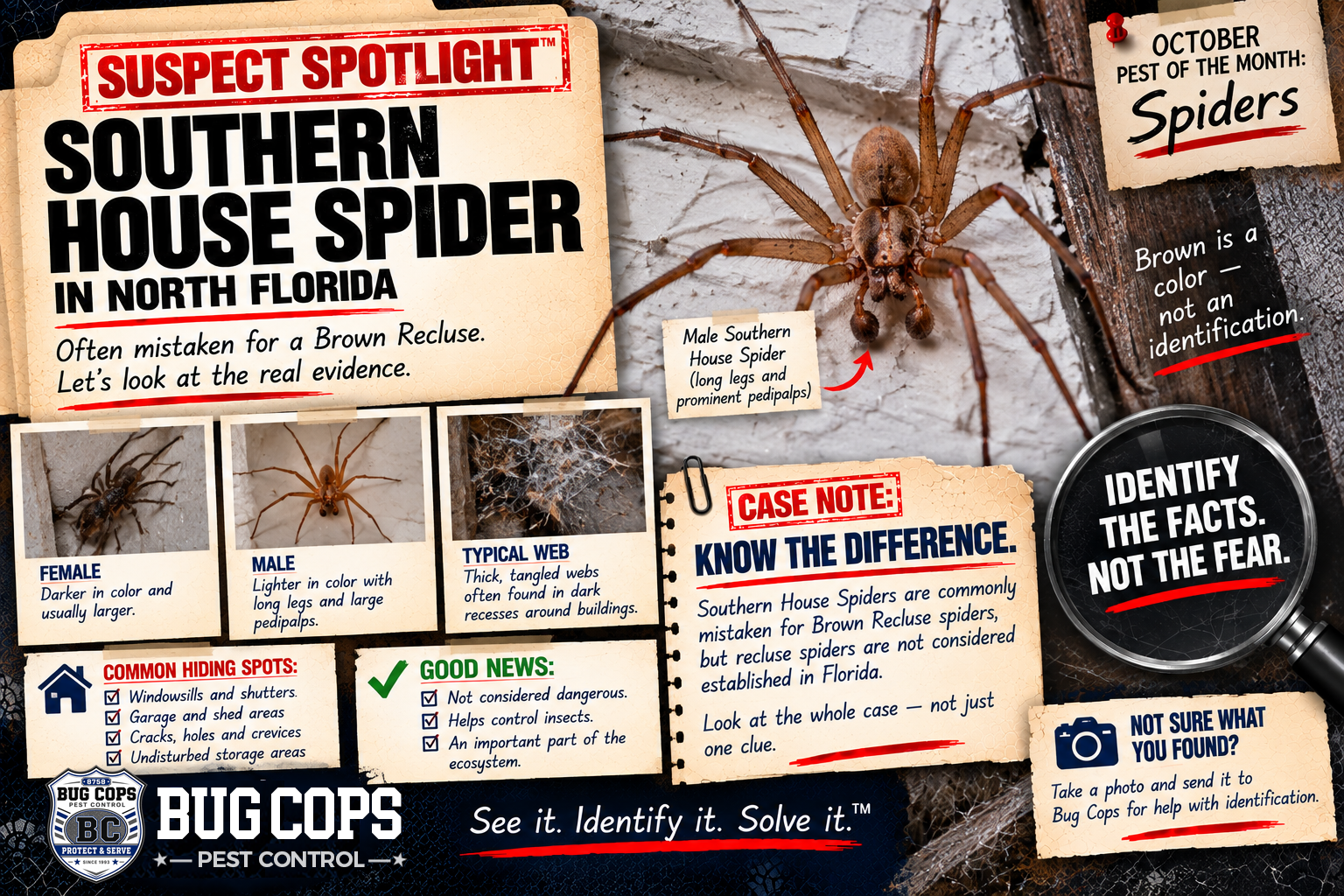
Suspect Spotlight™: Southern House Spiders in North Florida
Southern House Spiders are common throughout Florida, especially around buildings and other human-populated areas. A brown spider appears on the wall or races across the garage. Then comes the question:
“Is that a Brown Recluse?”
In Florida, there’s another suspect homeowners are much more likely to encounter—the Southern House Spider (Kukulcania hibernalis). The male Southern House Spiders are also frequently mistaken for Brown Recluse spiders because of their brown color and general shape.
That’s why this week’s case is really about more than one spider. It’s about mistaken identity.
Meet the Suspect: Southern House Spider
Southern House Spiders are sometimes called southern crevice spiders, which gives us a pretty good clue about where they like to live.
Males and females can look surprisingly different.
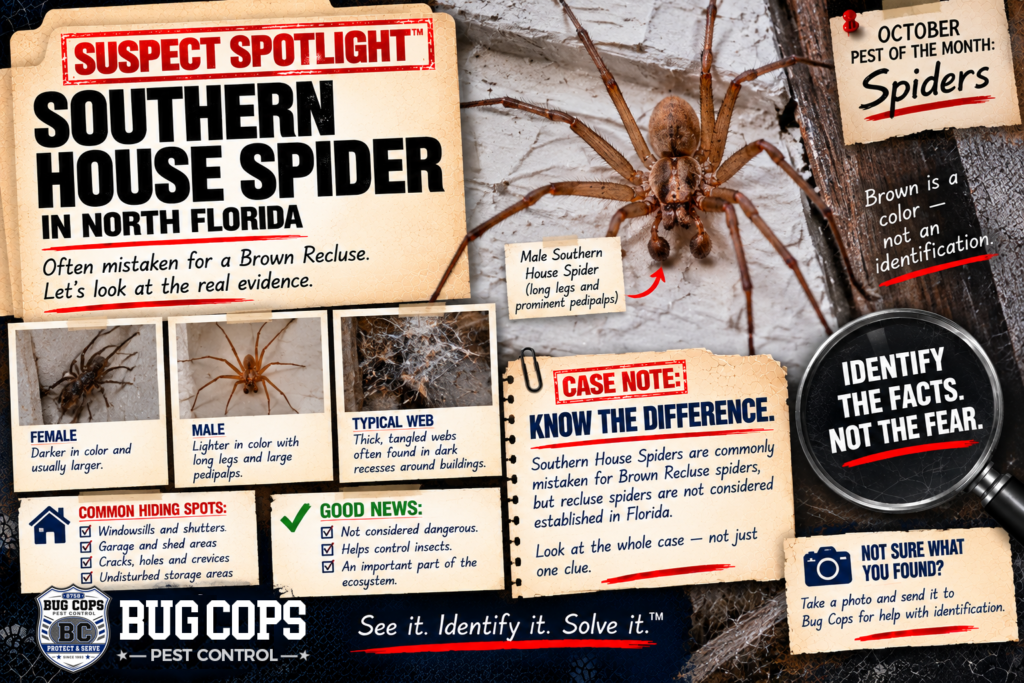
UF/IFAS describes females as charcoal gray and roughly ½ to ¾ inch in body length. Males are smaller-bodied, usually khaki to amber in color, with long, slender legs and unusually long pedipalps—the appendages near the mouth.
Those lighter-colored, lankier males are the ones that create much of the Brown Recluse confusion.

Identification Note: If you’re unsure about a spider, don’t handle it to get a closer look. A clear photograph taken from a safe distance is much more useful—and much safer.
Why Are They Called House Spiders?
Because they are very comfortable living around structures.
Southern House Spiders favor dark recesses around buildings, including windowsills, shutters and overhangs. Larger individuals use substantial cracks, holes and crevices where they can retreat from view.
During the day, a Southern House Spider may remain hidden inside its retreat. At night, it may emerge and sit near its web.
And that web provides another useful clue.
Southern House Spiders construct thick, tangled-looking webs. Over time, those webs can collect debris and remains from captured insects, giving them an especially messy appearance.
So when Bug Cops investigates a suspected Southern House Spider, we’re not just looking at the spider. We’re looking at the spider + the web + the location + the surrounding conditions.
The Brown Recluse Question
Here’s where this case gets especially interesting for Florida homeowners. UF/IFAS says there is currently no scientific evidence that any recluse spider is established in Florida. Recluse spiders have occasionally been intercepted here, but verified Florida records are limited.
That doesn’t mean a Brown Recluse could never turn up in Florida. It means that finding a brown spider in a Florida home does not justify automatically calling it a Brown Recluse.
UF/IFAS specifically identifies the male Southern House Spider as one of the spiders commonly confused with the Brown Recluse.
So How Can They Be Told Apart?
This is where proper identification matters. Brown Recluses have six eyes arranged in three pairs. Southern House Spiders have eight eyes grouped together. Male Southern House Spiders also have much longer pedipalps than Brown Recluses.
And what about the famous “violin” marking? It can be useful evidence, but UF/IFAS cautions that the violin-shaped marking on recluse spiders isn’t always consistent and shouldn’t be relied upon by itself for identification.
Once again:
One clue isn’t the whole case.
Is the Southern House Spider Dangerous?
Southern House Spiders are not known to have a dangerous bite.
UF/IFAS notes two reported bite cases that caused pain and swelling lasting up to two days, but this species is not considered medically significant in the way widow spiders are.
That doesn’t mean you should pick one up.
Any unfamiliar spider is better observed than handled, especially when identification is uncertain.
But it does illustrate exactly why correct identification matters.
Mistaking a Southern House Spider for a Brown Recluse can turn an ordinary Florida spider into a much more frightening situation than the evidence supports.
What Are They Doing Around the House?
Eating other arthropods.
Southern House Spiders capture a variety of insects in their webs. UF/IFAS lists prey that includes house flies, horse flies, cockroaches, May beetles and even mud daubers.
So although their messy webs may not win any decorating awards, these spiders can provide a useful ecological service.
That doesn’t mean homeowners need to accept webs covering windows or spiders living wherever they please.
It means the presence of a spider may also tell us something about the insects available for it to eat.
Follow the predator, and sometimes you find another pest story underneath it.
Making a Home Less Inviting
If Southern House Spiders repeatedly appear around a structure, don’t focus only on removing individual spiders.
Look at the conditions supporting them. UF/IFAS recommends repairing cracks and crevices around window casings, sealing spaces above and below doors, closing openings around water pipes and electrical lines, and repairing damaged screens.
Those steps can reduce spider entry. But they can also reduce the insects that spiders are following.
Regular vacuuming can remove webs, egg sacs and insect prey from undisturbed indoor areas as well.
In other words:
Close the gaps. Reduce the shelter. Follow the food.
Case File Summary
The Southern House Spider is common in Florida. It lives comfortably around structures. It builds distinctive tangled webs.
And the wandering male can look enough like a Brown Recluse to cause a case of mistaken identity. But Florida evidence matters: UF/IFAS does not consider Brown Recluse spiders established in the state.
So when a brown spider appears around a North Florida home:
Look at the whole case.
Not Sure Which Spider You Found?
Visit our Spider Identification Guide to compare common spiders found around North Florida homes.
If you have a clear photograph, you can also Send Us a Pest Photo and show Bug Cops what you’re seeing.
When It’s Time to Request Backup
Bug Cops provides spider control services throughout Clay and Putnam Counties. We begin by identifying the type of spider whenever possible and looking at where the activity is occurring, rather than focusing only on the spiders currently visible.
See it. Identify it. Solve it.™
Protecting what matters most.