
Wasps & Stinging Insects Identification Guide for Clay & Putnam Counties
This Wasps & Stinging Insects Identification Guide will help you recognize common stinging insects, understand where they may build nests, and identify features that can help distinguish one type from another.
Wasps and other stinging insects are commonly encountered around North Florida homes, lawns, landscaping, and outdoor structures. Activity may occur around rooflines, eaves, trees, shrubs, sheds, fences, and other protected areas where insects can forage or establish nests.
Not every flying insect around a home presents the same concern. Some stinging insects live in social colonies and may defend a nest, while others are solitary and generally less defensive. Correct identification can help determine what you’re seeing and whether an active nest may require closer attention.
Size and color alone aren’t enough for identification. Body shape, markings, leg position, nest type, flight behavior, and where activity is occurring can all provide useful clues when distinguishing wasps and other stinging insects.
Not sure what kind of stinging insect you’ve found? Take a clear photo and send it to Bug Cops. We’ll help you take a closer look at your suspect.
What Do Wasps & Stinging Insects Look Like?
This Wasps & Stinging Insects Identification Guide highlights insects that vary considerably in size, color, and body shape. Many have two pairs of wings, six legs, antennae, and a distinct separation between the thorax and abdomen, but their markings, body proportions, and behavior can help distinguish one type from another.
Wasps and stinging insects may have:
- Six legs
- Two antennae
- Two pairs of wings
- A distinct waist between the thorax and abdomen
- Yellow, black, brown, red, or metallic markings
- Smooth or sparsely haired bodies
- Body shapes that vary considerably by species
One useful identification feature is body shape and proportion. Paper wasps tend to have slender bodies with long legs that may hang visibly during flight, while yellowjackets are generally more compact and robust.
Nest type and behavior can be just as useful as appearance. Open paper combs, enclosed aerial nests, mud tubes or cells, and activity entering a ground opening can each point toward different stinging insects. Observing these clues from a safe distance can help narrow down what you’ve found.

Identification Note: Don’t identify a stinging insect by color alone. Look at body shape, markings, leg position, nest type, flight behavior, and where the activity is occurring for stronger identification clues.
Common Wasps & Stinging Insects in North Florida
North Florida is home to several types of wasps and other stinging insects, and they don’t all behave the same way. Some live in social colonies and may defend their nests, while others are solitary and are generally less defensive.
Paper Wasp
Polistes spp.
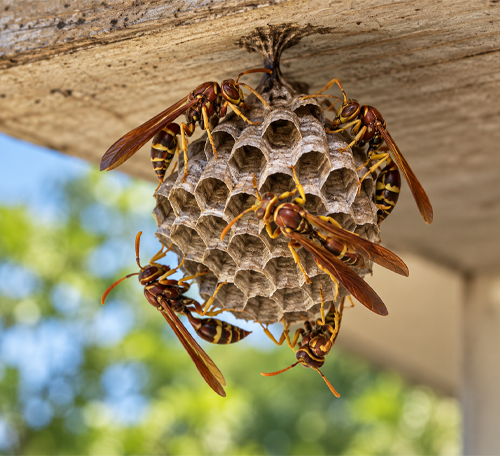
Paper wasps have slender bodies, narrow waists, and long legs that often hang beneath them during flight. They commonly build exposed, umbrella-shaped paper combs beneath eaves, porch ceilings, railings, and other protected areas.
Yellowjacket
Vespula spp.
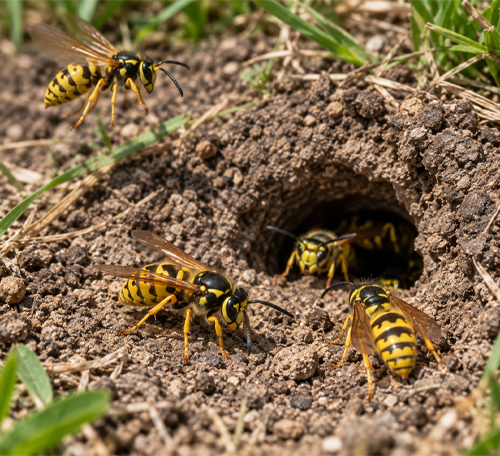
Yellowjackets are compact, strongly marked wasps, typically with contrasting yellow-and-black patterns. Many species establish colonies in the ground or protected cavities and may actively defend the nest area when disturbed.
Bald-Faced Hornet
Dolichovespula maculata
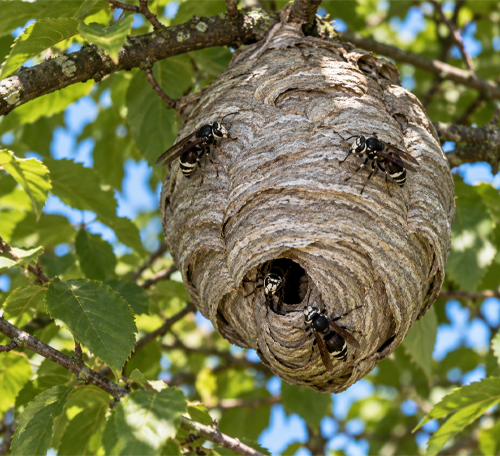
Bald-faced hornets are mostly black with distinctive white markings on the face and body. They construct large enclosed paper nests, often in trees, shrubs, or on structures.
Mud Dauber
Sceliphron spp.
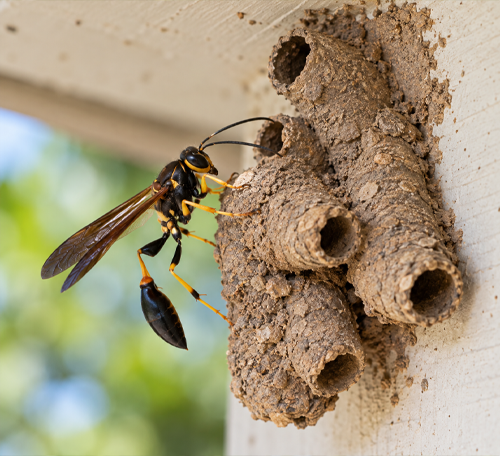
Mud daubers are slender solitary wasps, often recognized by their narrow waist and long body. They construct individual mud cells or tubes on walls, eaves, garages, sheds, and other sheltered surfaces.
Cicada Killer
Sphecius speciosus
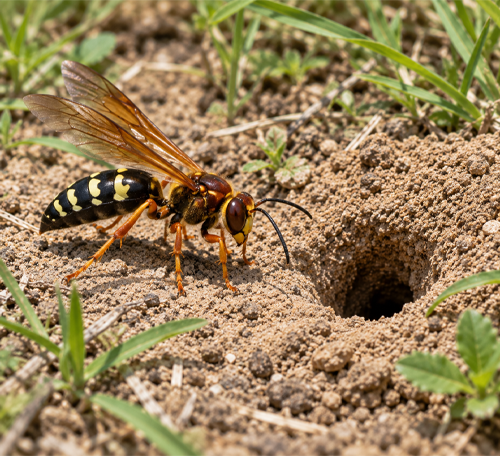
Cicada killers are large solitary wasps with dark bodies and yellow markings. Females excavate burrows in soil and provision them with cicadas; their large size can make them look more threatening than their generally solitary behavior suggests.
Scoliid Wasp
Scoliidae
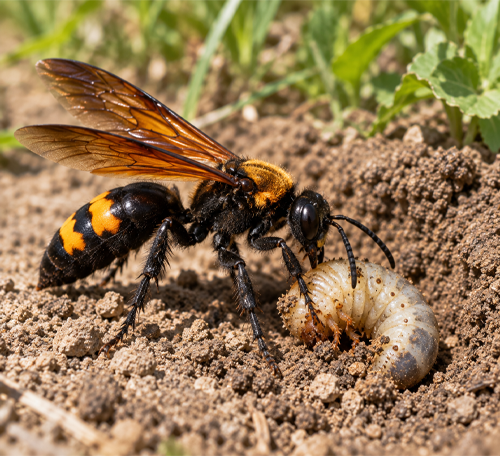
Scoliid wasps are robust, often dark-colored wasps that may have yellow, orange, or reddish markings. Adults are commonly seen visiting flowers or flying low over lawns while searching for beetle larvae.
Identification Note: Where a stinging insect is active can be an important clue. Nest location, nest construction, flight patterns, and repeated activity around the same opening can help narrow down what you’ve found.
Where Are Wasps & Stinging Insects Found Around the Home?
Wasps and other stinging insects may nest or forage in many areas around a property. Some build exposed nests, while others use protected cavities, soil, vegetation, or sheltered areas on structures. Watching activity from a safe distance can provide useful clues about where a nest may be located.
Eaves, Soffits & Rooflines
Paper wasps and other species may build nests beneath eaves, soffits, porch ceilings, roof overhangs, and other sheltered areas protected from weather.
Wall Voids & Structural Openings
Some social wasps may use wall voids or other protected cavities. Repeated insects entering and leaving the same crack, gap, or opening can indicate a nest concealed within the structure.
Trees & Shrubs
Enclosed paper nests may be built among branches of trees and shrubs, while other wasps may use vegetation for hunting, resting, or foraging.
Lawns & Ground Openings
Yellowjackets and some solitary wasps may use underground nesting sites. Repeated flight into and out of the same opening in soil can indicate established activity below ground.
Garages, Sheds & Sheltered Areas
Mud daubers and other solitary wasps may construct nests on walls, rafters, ceilings, and other protected surfaces in garages, sheds, porches, and similar sheltered spaces.
Flowers & Landscaping
Adult wasps may visit flowers for nectar or move through landscaping while hunting other insects. Seeing wasps around flowers does not necessarily mean a nest is nearby.
For more information about ants commonly found in and around Florida homes, visit the UF/IFAS Extension guide to stinging insects.
Identification Note: When you see an ant trail, don’t look only at where the ants are gathering. Follow the trail in both directions—the food or moisture source may be at one end while the nesting or entry area is somewhere else.
Signs of Wasp & Stinging Insect Activity
Stinging insect activity may involve more than seeing an occasional wasp flying through the yard. Repeated flight to the same location, visible nests, activity entering openings, ground-level traffic, and increasing numbers of insects can provide clues that a nest may be nearby.
Repeated Flight to the Same Location
Wasps repeatedly flying to and from the same eave, roofline, tree, shrub, wall opening, or other location may indicate an established nest nearby. Watching the flight path from a safe distance can provide useful clues.
Insects Entering Cracks or Openings
Repeated activity through the same gap, wall opening, soffit, siding, or structural cavity may indicate a concealed nest. The nest itself may not be visible from outside.
Visible Paper or Mud Nests
Open paper combs, enclosed paper nests, and mud cells or tubes can help identify the type of wasp using an area. Nest construction and location are often useful identification clues.
Ground-Level Activity
Repeated wasp traffic entering and leaving the same opening in soil may indicate an underground nest or burrow. Avoid disturbing the opening while trying to identify the insects.
Increasing Numbers Around One Area
An occasional wasp may simply be foraging, but repeated or increasing activity concentrated around one location can indicate a nearby nesting site or established travel pattern.
Defensive Behavior Near a Nest
Some social wasps may actively defend the area around an established nest. Increased activity when people approach a particular location can be a clue that a nest is nearby.
Identification Note: Don’t rely on the number of insects alone. Where they’re flying, where they disappear, the type of nest present, and whether activity repeatedly returns to the same location can provide stronger identification clues.
Why Am I Seeing Wasps & Stinging Insects?
Wasps and other stinging insects may appear around a property because they have found food, prey, water, suitable nesting conditions, or protected shelter. Seasonal changes and established nests can also cause activity to become more noticeable.
They’re Searching for Food or Prey
Adult wasps may visit flowers, fallen fruit, outdoor food, or other sources of sugars, while many species also hunt insects or spiders to provision their young.
They’ve Found Water
Wasps may visit birdbaths, pools, pet water bowls, irrigation areas, condensation, and other reliable water sources, especially during hot or dry weather.
A Nest Is Nearby
Repeated activity concentrated around the same location may indicate a nest in an eave, wall void, tree, shrub, ground opening, or other protected area. The nest itself may not always be visible.
Weather or Season Has Changed Their Activity
Warm weather, rainfall patterns, dry conditions, and seasonal colony growth can affect wasp activity. Some species become considerably more noticeable as colonies increase in size.
They’ve Found a Protected Nesting Site
Eaves, soffits, wall cavities, sheds, garages, vegetation, and sheltered structural areas can provide protection from weather and suitable places for nest construction.
The Colony Has Become Established
Social wasp colonies may become more noticeable as the number of workers increases. Repeated traffic to and from the same location can indicate an established nest nearby.
Identification Note: If stinging insects keep returning, look at what they’re doing as well as where they’re going. Feeding, hunting, collecting water, and repeatedly returning to a nest can produce very different activity patterns.
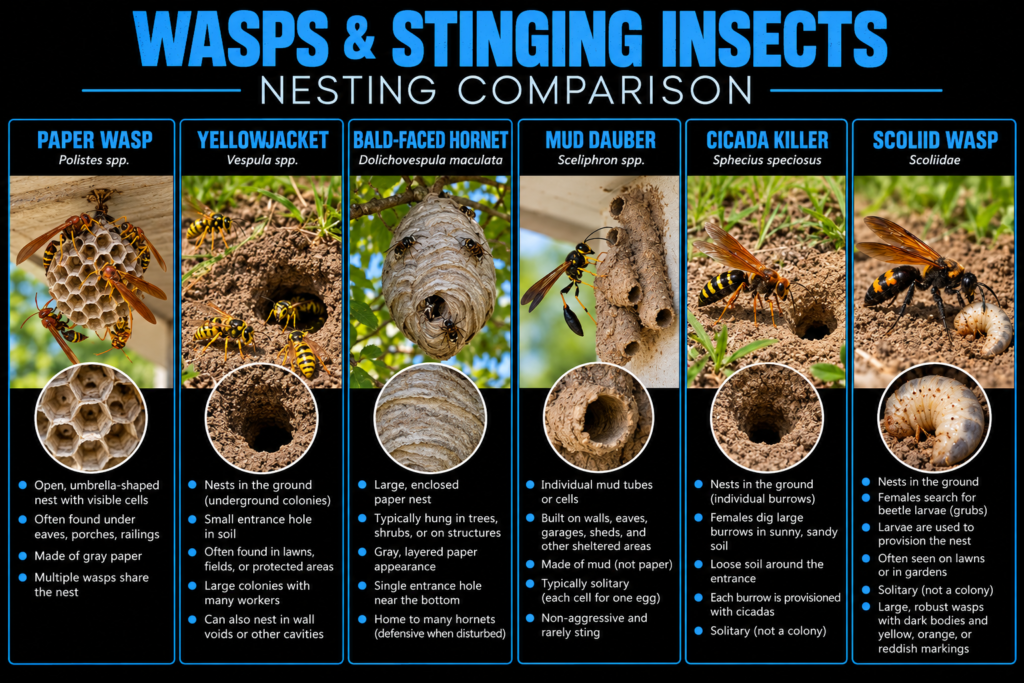
Identifying Stinging Insects by Their Nests
This Wasps & Stinging Insects Identification Guide uses nest type as one of the strongest identification clues. Nest material, shape, location, and whether the nest is exposed, concealed, or underground can help narrow down the suspect without approaching it closely.
Paper Wasp — Open Paper Comb
Paper wasps build exposed, umbrella-shaped paper combs with visible open cells. Nests are commonly attached beneath eaves, porch ceilings, railings, and other sheltered surfaces.
Yellowjacket — Concealed Nest
Yellowjackets often establish colonies underground or inside protected cavities. Repeated workers entering and leaving the same small opening may be more noticeable than the nest itself.
Bald-Faced Hornet — Enclosed Paper Nest
Bald-faced hornets construct large, enclosed gray paper nests that may hang from tree branches, shrubs, or structures. Unlike a paper wasp nest, the comb is enclosed within a protective outer covering.
Mud Dauber — Mud Cells or Tubes
Mud daubers construct individual mud cells or tube-like nests on walls, rafters, eaves, garages, sheds, and other protected surfaces. Their nests look very different from paper-built social wasp nests.
Cicada Killer — Soil Burrow
Female cicada killers excavate burrows in the soil, often leaving loose or displaced soil near the entrance. Several individual burrows may occur in the same favorable area even though these wasps are solitary.
Scoliid Wasp — Underground Nesting
Scoliid wasps are solitary and nest in the soil, where females search for beetle larvae to provision their young. Their nesting activity generally does not produce the conspicuous communal nest seen with social wasps.
Identification Note: Never approach or disturb a nest just to identify it. Nest shape, construction material, location, and insect traffic can often provide useful clues from a safe distance.
When Should I Be Concerned About Wasps & Stinging Insects?
Seeing an occasional wasp around flowers or landscaping does not necessarily mean a nest is nearby. However, repeated activity in one location, increasing numbers, a visible or concealed nest, defensive behavior, or activity around frequently used areas can warrant closer attention.
Stinging Insects Keep Returning
Repeated activity in the same location may indicate a reliable food or water source, an established flight route, or a nest nearby. Watch where the insects are going from a safe distance.
Large Numbers Are Appearing
An occasional foraging wasp may be normal outdoors, but increasing numbers concentrated around one area can indicate an established nest or colony nearby.
A Nest Is Near a Frequently Used Area
A nest near a doorway, walkway, patio, play area, work area, or other frequently used location may increase the chance of people accidentally disturbing it.
Insects Are Entering a Structural Opening
Repeated wasps entering and leaving the same soffit, wall gap, roofline, siding opening, or other structural cavity may indicate a concealed nest.
Ground Activity Is Concentrated in One Area
Repeated insects entering and leaving the same soil opening can indicate an underground nest or burrow. Avoid approaching or disturbing the opening to investigate.
Defensive Behavior Is Increasing
Some social wasps may actively defend an established nest. Wasps repeatedly approaching people or becoming more active when a particular area is approached can indicate a nearby colony.
Not sure what kind of stinging insect or nest you’ve found? Bug Cops Pest Control offers free home inspections to help identify what you’re dealing with and determine the appropriate next step.

Inspection Note: Recurring stinging insect activity can provide important clues. We look at where insects are active, where they disappear, what type of nest may be present, and whether the nest location could increase the chance of accidental disturbance.
Wasps & Stinging Insects Identification Guide FAQs
Look at body shape, markings, leg position, flight behavior, nest type, and where the insect is active. Color alone is not enough because several unrelated wasps may have similar markings.
Not necessarily. Wasps may visit flowers, hunt other insects, collect water, or forage for food away from their nest. Repeated traffic to and from the same location is a stronger clue that a nest may be nearby.
Paper wasps typically build exposed combs with visible open cells. Bald-faced hornets build enclosed paper nests with a protective outer covering, often in trees, shrubs, or on structures.
Some stinging insects use underground nesting sites. Yellowjackets may establish social colonies below ground, while solitary wasps such as cicada killers excavate individual soil burrows. Identifying the insect and observing the activity from a safe distance can help distinguish them.
Mud daubers are solitary wasps and are generally less defensive around their nests than social species such as yellowjackets. However, stinging insects should still be observed without handling or deliberately disturbing them.
Not Sure What Kind of Stinging Insect You’ve Found?
This Wasps & Stinging Insects Identification Guide can help when body shape, markings, behavior, and nest type make identification difficult. A clear photo of the insect or nest can often provide useful identification clues.
Don’t guess. If you’ve found a stinging insect or nest you don’t recognize, take a clear photo from a safe distance and send it to Bug Cops. We’ll help you take a closer look at your suspect.
Protecting & Serving Clay and Putnam Counties Since 1993
If stinging insect activity keeps returning around your home or property, Bug Cops Pest Control can help identify the insect, evaluate where activity may be originating, and determine whether an active nest may require closer attention.
Free home inspections are available if you’d like us to take a closer look.