
Carpenter Ant Identification Guide for Clay & Putnam Counties
This Carpenter Ant Identification Guide will help you recognize carpenter ants, identify signs of nesting activity, and understand how they differ from termites and other ants found around North Florida homes.
Carpenter ants are among the larger ants homeowners may encounter in Florida. They may be seen traveling along foundations, trees, fences, rooflines, or inside structures while searching for food, moisture, and suitable nesting sites.
Unlike termites, carpenter ants do not eat wood. They excavate galleries in wood to create nesting space and often take advantage of wood that has been softened or damaged by moisture. Their presence around a structure can sometimes point to moisture conditions or areas that deserve closer inspection.
Size and color alone are not enough for identification. Body shape, the narrow waist, elbowed antennae, worker size, nesting location, and evidence associated with their galleries can all help distinguish carpenter ants from termites and other insects.
Not sure if you’ve found a carpenter ant? Take a clear photo and send it to Bug Cops. We’ll help you take a closer look at your suspect.
What Do Carpenter Ants Look Like?
This Carpenter Ant Identification Guide focuses on one of the larger ants commonly encountered around North Florida homes. Like other ants, they have three main body sections—the head, thorax, and abdomen—but several features can help distinguish carpenter ants from termites and other ants.
Carpenter ants typically have:
- Six legs
- Two elbowed antennae
- A narrow, pinched waist
- One visible waist node
- A smoothly rounded thorax when viewed from the side
- Strong mandibles used for excavating nesting galleries
- Workers that may vary noticeably in size
One useful carpenter ant feature is the smoothly rounded profile of the thorax. Combined with the ant’s elbowed antennae, narrow waist, and single waist node, this can help distinguish carpenter ants from other ants.
Worker size can vary considerably within the same carpenter ant colony, so finding ants of different sizes does not necessarily mean you’re seeing different species. Color can vary as well, making body shape and structural features more useful than color alone for identification.
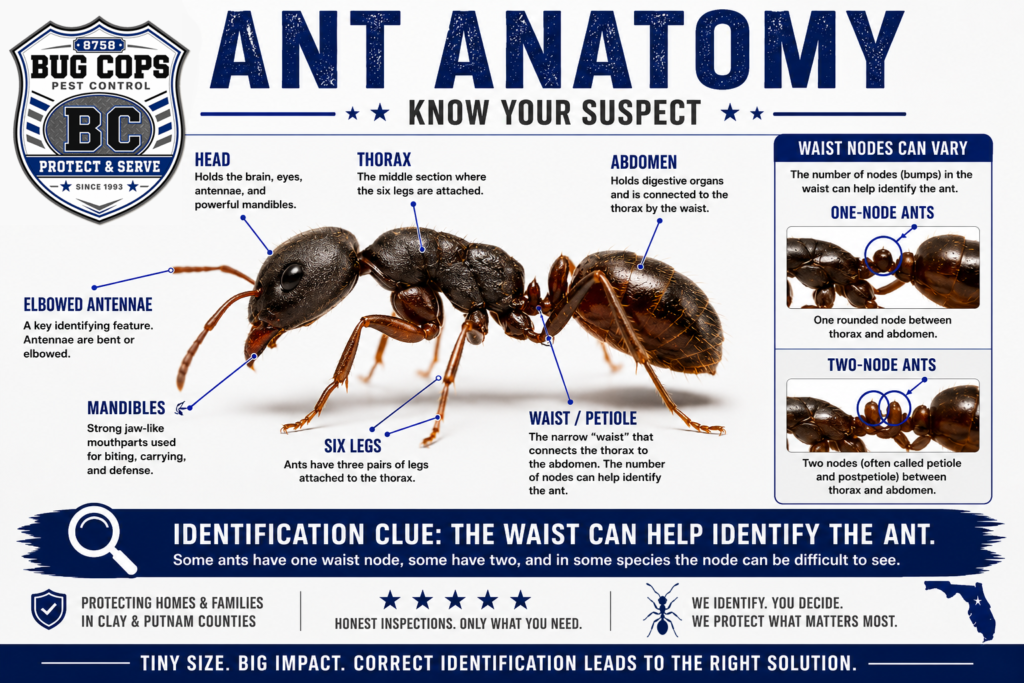

Identification Note: Carpenter ants can vary in size and color. Look for elbowed antennae, a narrow waist, one waist node, and a smoothly rounded thorax, along with where the ants are traveling or nesting.
Carpenter Ants vs. Termites
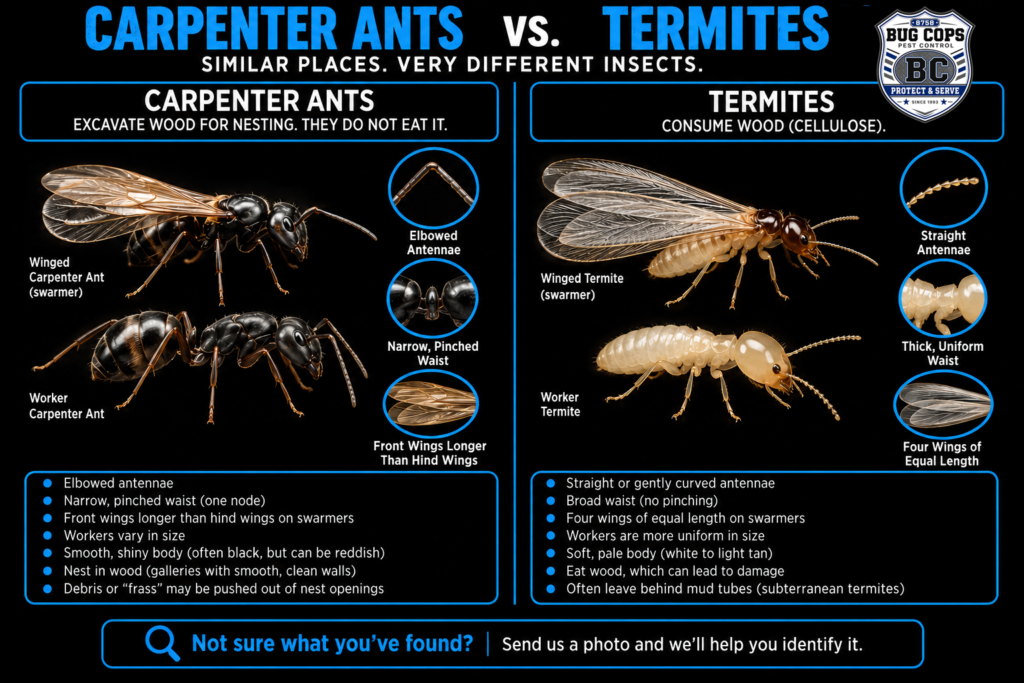
Carpenter ants and termites may both be associated with wood, but they are very different insects. Looking closely at body shape, antennae, wings, and the evidence they leave behind can help tell them apart.
CARPENTER ANTS
Look for:
- Elbowed antennae
- Narrow, pinched waist
- Front wings longer than hind wings on swarmers
- Workers of noticeably different sizes
- Smooth, cleaned-out galleries in wood
- Debris or material pushed from nesting areas
Important: Carpenter ants excavate wood for nesting; they do not eat it.
TERMITES
Look for:
- Straight or gently curved antennae
- Broad waist without the ant’s pinched appearance
- Four wings of roughly equal length on swarmers
- Workers generally more uniform in appearance
- Wood damage that may contain soil or mud
- Mud tubes associated with subterranean termite activity
Important: Termites consume cellulose, including wood.
Identification Note: Finding insects associated with damaged wood does not identify the cause by itself. Look at the insect, the type of damage, moisture conditions, and other evidence together before drawing a conclusion.
Where Are Carpenter Ants Found Around the Home?
Carpenter ants may establish nests indoors or outdoors, often in areas where moisture, damaged wood, or protected spaces provide suitable conditions. Workers can travel well away from the colony while foraging, so following where carpenter ants are coming from—and where they’re going—can provide useful clues about where a nest may be located.
Moisture-Damaged Wood
Carpenter ants often take advantage of wood affected by moisture or decay. Areas around leaks, plumbing, roof damage, and other persistent moisture sources may provide suitable nesting conditions.
Wall Voids & Structural Spaces
Workers may travel through wall voids, around windows and doors, beneath siding, or through other protected spaces. Seeing ants indoors does not necessarily reveal where the main colony is located.
Trees, Stumps & Logs
Tree cavities, dead limbs, stumps, logs, and damaged wood can provide natural nesting sites. Carpenter ants originating outdoors may forage considerable distances from their nest.
Rooflines & Eaves
Moisture around roof edges, fascia, soffits, gutters, and damaged exterior wood can create conditions carpenter ants may use for nesting or travel.
Landscaping & Mulch
Trees, shrubs, landscape timbers, mulch, and other materials near a structure can provide shelter or pathways for carpenter ants moving between outdoor nesting areas and buildings.
Foundations & Exterior Walls
Workers may travel along foundations, utility lines, fences, branches, and exterior walls while foraging. Following established trails can sometimes help determine where ants are coming from or going.
For more information about ants commonly found in and around Florida homes, visit the UF/IFAS Extension guide to carpenter ants.
Identification Note: When you see an ant trail, don’t look only at where the ants are gathering. Follow the trail in both directions—the food or moisture source may be at one end while the nesting or entry area is somewhere else.
Signs of Carpenter Ant Activity
Carpenter ant activity may involve more than seeing an occasional worker. Repeated trails, excavated material, activity around moisture-damaged wood, winged ants, and workers of different sizes can provide clues that a colony may be nearby.
Established Carpenter Ant Trails
Workers may follow established routes along foundations, exterior walls, fences, tree limbs, utility lines, or structural edges. Repeated activity along the same route can provide clues about where ants are traveling to or from.
Ants Emerging From Cracks or Gaps
Carpenter ants repeatedly appearing from wall voids, window or door frames, beneath siding, around plumbing penetrations, or other openings may indicate a nearby nesting or travel area.
Excavated Material
Carpenter ants remove material while creating nesting galleries. Small piles of wood fragments, insect parts, or other debris near cracks, openings, or damaged wood may provide evidence of excavation nearby.
Winged Carpenter Ants
Winged reproductive carpenter ants may appear when established colonies produce new queens and males. Finding numerous winged ants indoors can warrant closer inspection because the source may be within or near the structure.
Activity Around Moisture or Damaged Wood
Repeated activity near leaks, plumbing, roof damage, window or door frames, or other damp areas may point toward conditions that provide suitable carpenter ant nesting sites.
Workers of Different Sizes
Carpenter ant colonies can contain workers of noticeably different sizes. Seeing large and small workers traveling together can therefore support identification rather than indicating several different ant species.
Identification Note: Don’t focus only on how many carpenter ants you see. Where they’re traveling, where they disappear, whether worker sizes vary, and what physical evidence is nearby can provide better clues about where activity may originate.
Why Am I Seeing Carpenter Ants?
Carpenter ants usually appear around a home because they have found food, moisture, suitable nesting conditions, or a travel route from an outdoor colony. Following their movement and looking at nearby conditions can help explain why activity is occurring.
They’re Foraging for Food
Carpenter ants forage for a variety of foods, including sweets and protein sources. Once workers locate food, they may establish trails that bring additional ants back to the same area.
They’re Looking for Moisture
Activity around plumbing, damp wood, condensation, roof leaks, or other moisture sources may increase when carpenter ants are searching for suitable nesting or foraging conditions.
A Colony Is Nesting Nearby
The ants you see may be workers traveling from a nest in a tree, stump, damaged wood, wall void, or another protected location. Visible workers may represent only a small portion of the colony.
Weather Has Changed Their Activity
Heavy rain, dry conditions, heat, cold snaps, and other environmental changes can alter carpenter ant movement and foraging behavior, sometimes making activity suddenly more noticeable.
Outdoor Ants Found a Way Inside
Carpenter ants nesting outdoors may enter along tree limbs, utility lines, foundations, rooflines, doors, windows, or structural gaps while searching for food or suitable conditions.
The Colony Has Become Established
Repeated trails or activity returning to the same location can indicate an established foraging route or nearby nest. Removing only the workers you see may not address where the activity originates.
Identification Note: If carpenter ants keep returning, look beyond where they enter. Moisture, damaged wood, outdoor nesting sites, and established travel routes can all contribute to recurring activity.
Carpenter Ant Prevention Tips
This Carpenter Ant Identification Guide also highlights conditions that may encourage activity around a home. Prevention starts with reducing moisture, suitable nesting sites, and easy access to the structure. Paying attention to leaks, damaged wood, vegetation, entry points, and recurring trails can make a property less favorable for carpenter ant activity.
Address Moisture Sources
Repair leaks when practical and watch for persistent moisture around plumbing, rooflines, windows, doors, and other structural areas. Correcting moisture problems can help reduce conditions that favor carpenter ant nesting.
Repair Damaged Wood
Replace or repair deteriorated, moisture-damaged, or decaying wood when appropriate. Carpenter ants often take advantage of wood that already provides suitable conditions for excavation.
Seal Accessible Entry Points
Check gaps around doors, windows, plumbing, utility penetrations, siding, and other openings. Sealing accessible cracks and gaps can help reduce routes carpenter ants may use to enter a structure.
Manage Vegetation Near the Home
Trim tree limbs and vegetation that contact the structure when practical. Branches, vines, shrubs, and other vegetation can provide carpenter ants with routes to rooflines and exterior walls.
Remove Favorable Nesting Material
When practical, address dead wood, stumps, logs, damaged landscape timbers, and other deteriorating wood near the structure that may provide carpenter ants with suitable nesting sites.
Pay Attention to Recurring Trails
If carpenter ants repeatedly follow the same route, note where the trail begins, where it ends, and where workers disappear. Those observations can provide useful clues when locating the source of activity.
Inspection Note: Carpenter ant prevention works best when moisture, damaged wood, entry points, vegetation, outdoor nesting sites, and established travel routes are considered together.
When Should I Be Concerned About Carpenter Ants?
Seeing an occasional carpenter ant does not necessarily mean a colony is nesting inside the home. However, recurring activity, large numbers indoors, winged carpenter ants, excavated material, or activity associated with structural wood can provide reasons for a closer inspection.
Carpenter Ants Keep Returning
If carpenter ants repeatedly appear in the same location after visible workers are gone, there may be an established foraging route or nesting site nearby.
Large Numbers Are Appearing Indoors
A few wandering workers may be scouts, but steady trails or increasing numbers indoors can indicate an established foraging route or a colony located in or near the structure.
Winged Carpenter Ants Are Found Indoors
Winged carpenter ants are reproductive members of an established colony. Finding numerous winged ants emerging indoors—particularly from the same area—can indicate that a colony is nearby. Correct identification is important because winged ants are often confused with termite swarmers.
Excavated Material Is Appearing
Small piles of wood fragments, insect remains, or other debris appearing beneath openings or near damaged wood may indicate carpenter ants are excavating a nesting area nearby.
Activity Is Associated With Moisture or Damaged Wood
Repeated carpenter ant activity around leaks, deteriorated wood, rooflines, window frames, plumbing, or other moisture-prone areas deserves closer attention because those conditions may provide suitable nesting sites.
Activity Is Coming From a Wall or Structural Area
Carpenter ants repeatedly disappearing into or emerging from wall gaps, baseboards, window frames, plumbing penetrations, or other structural openings may indicate a protected nesting or travel area that isn’t visible from the room.
Not sure whether you’re seeing carpenter ants or termite swarmers? Bug Cops Pest Control offers free home inspections to help identify what you’re dealing with and determine the appropriate next step.

Inspection Note: Recurring carpenter ant activity can provide important clues. We look at where workers emerge, where they disappear, whether winged ants are present, and whether moisture or damaged wood may be contributing to the activity.
Carpenter Ant Identification Guide FAQs
No. Carpenter ants do not eat wood. They excavate wood to create nesting galleries, while termites consume cellulose-containing materials. Because both may be associated with wood, correct identification is important.
Carpenter ants have elbowed antennae and a narrow, pinched waist. Winged carpenter ants also have front wings that are longer than their hind wings. Termite swarmers have a broader waist, straighter antennae, and four wings of roughly equal length.
Workers may enter while searching for food or moisture, or they may be traveling from a nest located indoors or nearby. Following where the ants appear and where they disappear can provide useful clues about the source.
Not necessarily. Carpenter ants may simply be foraging indoors from an outdoor colony. However, repeated activity around moisture-damaged wood, structural openings, or excavated material deserves closer inspection.
Carpenter ant colonies can contain workers of noticeably different sizes. Seeing both large and small workers together can therefore be a useful identification clue rather than evidence of several different ant species.
Not Sure If You’ve Found Carpenter Ants?
This Carpenter Ant Identification Guide can help when carpenter ants are confused with other ants or when winged ants are mistaken for termite swarmers. Body shape, antennae, worker size, nesting location, and nearby evidence can all help with identification.
Don’t guess. If you’ve found ants you don’t recognize, take a clear photo and send it to Bug Cops. We’ll help you take a closer look at your suspect.
Protecting & Serving Clay and Putnam Counties Since 1993
If carpenter ant activity keeps returning around your home or property, Bug Cops Pest Control can help identify the ants, evaluate where the activity may be originating, and whether moisture, damaged wood, or other conditions may be contributing.
Free home inspections are available if you’d like us to take a closer look.