
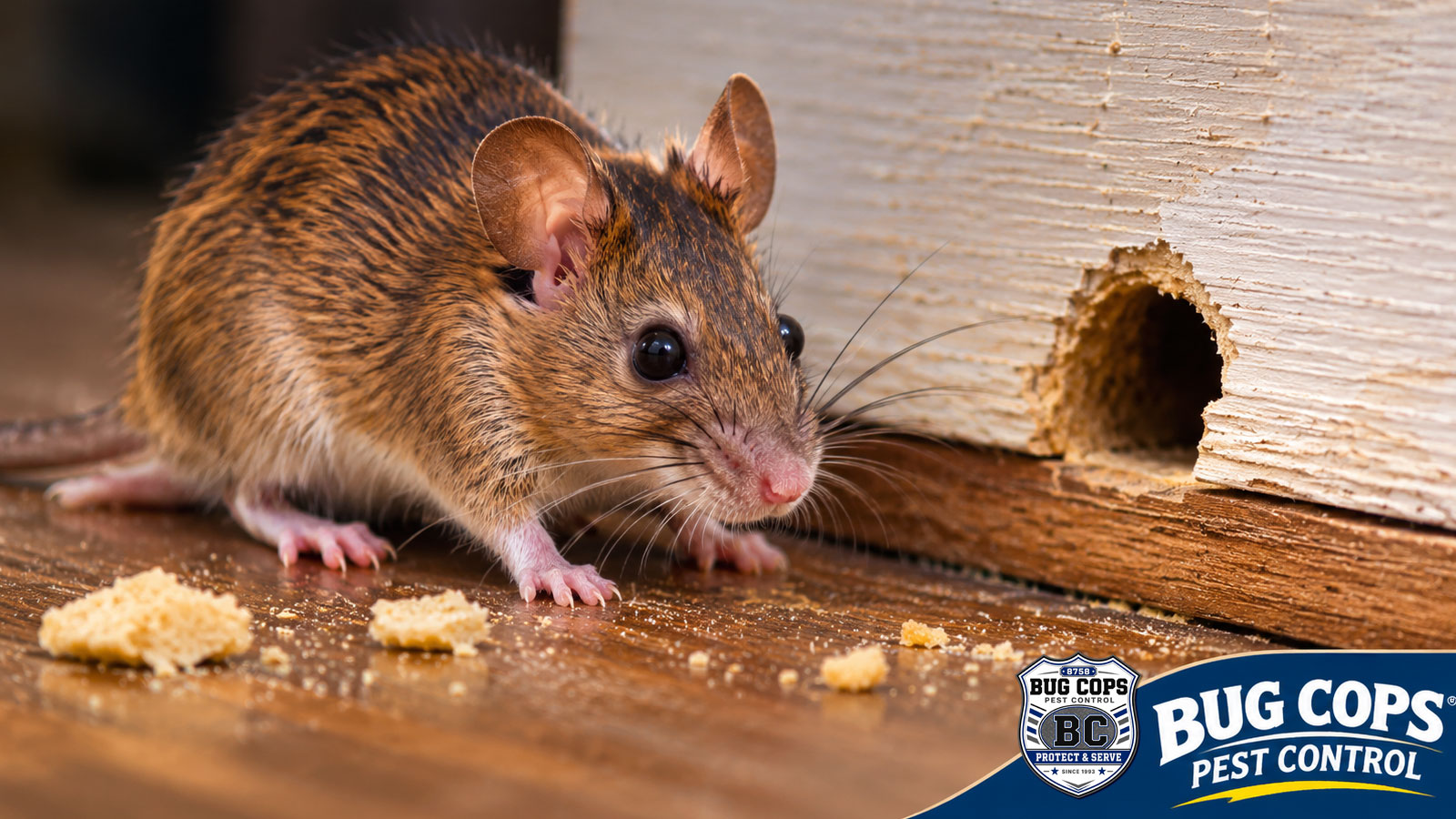
Suspect Spotlight™: House Mice in North Florida
The House Mouse (Mus musculus) is small, lightweight, and capable of taking advantage of openings around a home that are surprisingly easy to overlook.
After investigating Roof Rats and Norway Rats, this week’s suspect may seem considerably less imposing. But don’t let its size fool you. A mouse can squeeze through an opening roughly the width of a pencil.
Small animal. Small opening. Potentially a lot of evidence.
Let’s open the case file.

The Suspect Profile: House Mouse
House Mice are considerably smaller than the rats we’ve investigated this month. They have slender bodies, relatively large ears, pointed noses, and long, thin tails. Their small size affects where they can enter, where they hide, and how we investigate their activity.
Like other rodents, mice may leave evidence long before homeowners actually see one. Droppings, gnaw marks, damaged packaging, and shredded nesting material can all provide clues. The CDC identifies these signs as common evidence of rodent activity.
That brings us back to November’s most important rule:
Don’t wait for the suspect. Follow the evidence.
How Small Is Small?
Here’s a fact that can change the way you look at your home. According to the CDC, a mouse can fit through an opening about ¼ inch wide, roughly the width of a pencil. UF/IFAS provides similar guidance when discussing ways to keep House Mice out of buildings.
That means a small gap beneath a door, around a utility line, or where building materials meet may deserve a closer look. Garage doors, exterior trim, vents, and damaged screens are also worth checking.
CASE NOTE
If a pencil can fit through an opening, take a closer look. That doesn’t prove mice are using the gap, but it identifies a possible entry point. When you find an opening near droppings, gnaw marks, or other recurring evidence, you’re beginning to build a case.
The Suspect May Be Closer Than You Think
Here’s an interesting difference between mice and the rats we’ve already investigated: House Mice often stay relatively close to their shelter. UF/IFAS reports that they commonly range only about 10–30 feet from their harborage while searching for food.
Think about what that means during an inspection. If fresh evidence repeatedly appears inside one pantry, cabinet, or garage corner, the mouse may not be traveling across the entire house every night. Its shelter could be nearby.
That’s why the location of the evidence matters just as much as the evidence itself. A dropping provides one clue, but the room, nearby openings, and surrounding conditions help us understand the bigger picture. piece by itself.
That Shredded Paper May Have a Purpose
Finding shredded paper inside a cabinet doesn’t necessarily mean a mouse was simply chewing things up. It may have been collecting nesting material.
House Mice build nests from soft materials such as paper, cloth, insulation, and other items they can gather in protected areas. UF/IFAS identifies shredded materials as a common sign of mouse nesting activity.
During an inspection, we want to know where the material came from and where it ended up. Is it concentrated inside a cabinet, storage box, or wall opening? Does it appear alongside droppings or other evidence?
Sometimes what looks like random damage is actually a clue to the animal’s behavior.
How Much Food Does a Mouse Actually Need?
Not much. UF/IFAS reports that a House Mouse may survive on approximately one-tenth of an ounce of food per day and roughly one-twentieth of an ounce of water. If its food contains enough moisture, it may survive without a separate source of free water.
A mouse doesn’t need a forgotten sandwich sitting on the counter. Small amounts of accessible food can matter, including pet food, birdseed, pantry spills, crumbs, and food inside damaged packaging.
This is also why rodent activity doesn’t automatically mean someone keeps a dirty house. Good sanitation helps reduce available food, but even a clean home can experience mouse activity when entry points and other favorable conditions remain.
A mouse doesn’t need very much to get by.
Mouse vs. Rat: Who Investigates the New Thing?
Remember our Roof Rat Spotlight? We learned that rats can be cautious around unfamiliar objects, including traps. House Mice often behave differently.
The CDC notes that House Mice and deer mice may be trapped more quickly than rats because they tend to be less cautious around new objects.
Our November suspects give us an interesting behavioral contrast:
Rat: “What is that new thing? I’m staying away from it.”
House Mouse: “What’s that new thing?”
Of course, individual animals vary. However, understanding these general differences can help when developing a control strategy.
Identification changes the investigation.
Small Doesn’t Mean Ground-Bound
Because House Mice are small, it’s easy to assume we should concentrate our investigation along the floor. But mice are capable climbers and can use shelving, stored materials, cabinets, and other structural features to move through a home.
Evidence may appear inside cabinets, on shelves, around stored food, or in protected wall spaces. That’s why an inspection shouldn’t stop at the baseboards.
Think small, but don’t look down only.
Real animals don’t always behave exactly the way we expect. Following the evidence helps us avoid overlooking important areas.
No Sighting Doesn’t Mean No Activity
You don’t have to watch a mouse run across the kitchen floor before taking other evidence seriously. The CDC explains that signs of rodents often appear before the animals themselves are seen.
Common clues include droppings, gnaw marks, damaged food packaging, shredded nesting material, scratching or rustling sounds, and tracks. Repeated evidence in the same protected area may help narrow down where activity is occurring.
However, there’s an important distinction between old evidence and current activity. One old dropping may indicate that a rodent was present at some point, but it doesn’t necessarily mean the animal is still there.
After an area has been safely cleaned, fresh droppings, new gnaw marks, or recurring signs provide stronger evidence of continuing activity.
The pattern matters more than any single clue.
How Quickly Can Mouse Activity Grow?
House Mice have substantial reproductive potential. UF/IFAS reports that females may become sexually mature at around six weeks of age and produce roughly five to six young per litter. Under favorable conditions, they may produce multiple litters during a year.
Those numbers sometimes turn into ridiculous predictions about one mouse becoming millions of mice overnight. We’re not doing that.
Real populations depend on food, shelter, survival, competition, and other environmental conditions. The important lesson is much simpler: persistent mouse activity deserves attention.
When fresh signs continue appearing, delaying an investigation may give an established population more time to reproduce and spread.
What About Health Concerns?
House Mice deserve the same sensible precautions we’ve discussed with rats. The CDC warns that rodents can carry germs capable of causing illness. Exposure may occur through contact with rodents, their urine, droppings, or saliva. Rodents may also carry ticks, fleas, or mites.
You cannot tell whether an individual mouse carries a disease simply by looking at it. The practical response is to avoid unnecessary contact and handle contaminated areas carefully.
There’s no need to panic. Proper precautions are what matter.
Don’t Sweep or Vacuum Dry Droppings
If you find mouse droppings or nesting material, do not sweep or vacuum them while they’re dry. Doing so can release contaminated particles into the air.
CDC cleanup guidance recommends wearing appropriate gloves, thoroughly wetting contaminated material with a suitable disinfectant, allowing the required contact time, and then wiping up the material. Follow the disinfectant label and current CDC instructions.
Our November 23 Signs of Rodent Activity Suspect Spotlight™ will cover documentation and cleanup in more detail.
For now, safety comes first. If you can safely photograph the evidence before cleaning, that’s helpful. But a photograph is never worth unnecessary exposure.
Removing the Mouse Isn’t the Whole Solution
Suppose you remove a House Mouse from your home. What happens to the quarter-inch opening it used? What about the accessible food or protected nesting area?
If those conditions remain, the property may still be vulnerable to rodent activity.
The CDC‘s rodent-prevention approach emphasizes finding and sealing entry points, addressing rodents already inside, reducing available food and shelter, and safely cleaning contaminated areas.
That’s why our November investigations keep returning to the same principle:
Removing the suspect isn’t necessarily the same as solving the case.
Case File Summary: House Mouse
The House Mouse may be the smallest suspect in November’s lineup, but its size is exactly what makes it interesting.
The House Mouse may be the smallest suspect in November’s lineup, but its size is exactly what makes it interesting. A pencil-width opening may provide access to a home, and the animal may stay relatively close to its shelter while searching for food.
It needs surprisingly little food, can use shredded household materials for nesting, and may investigate unfamiliar objects more readily than rats. Most importantly, homeowners may discover all this evidence before ever seeing the mouse.
Precinct Note: THINK SMALL. FOLLOW THE EVIDENCE.
Examine possible entry points, pay attention to where evidence appears, and watch for patterns. Even the smallest suspect can leave important clues.
Finding Mouse Evidence Around Your Home?
Visit the Bug Cops House Mouse Identification Guide for identification clues and common signs of activity.
If you’ve discovered droppings, gnaw marks, nesting material, or other evidence but haven’t seen the animal, our Signs of Rodent Activity Identification Guide can help you understand what to look for.
Bug Cops also provides rodent inspections and control services for homes in Clay and Putnam Counties, Florida.
Request a Free Inspection
Seeing signs of rodent activity? Let Bug Cops help investigate.
Call Bug Cops
Have questions about possible rodent activity? Give our team a call.
See it. Identify it. Solve it.™
Protecting what matters most.