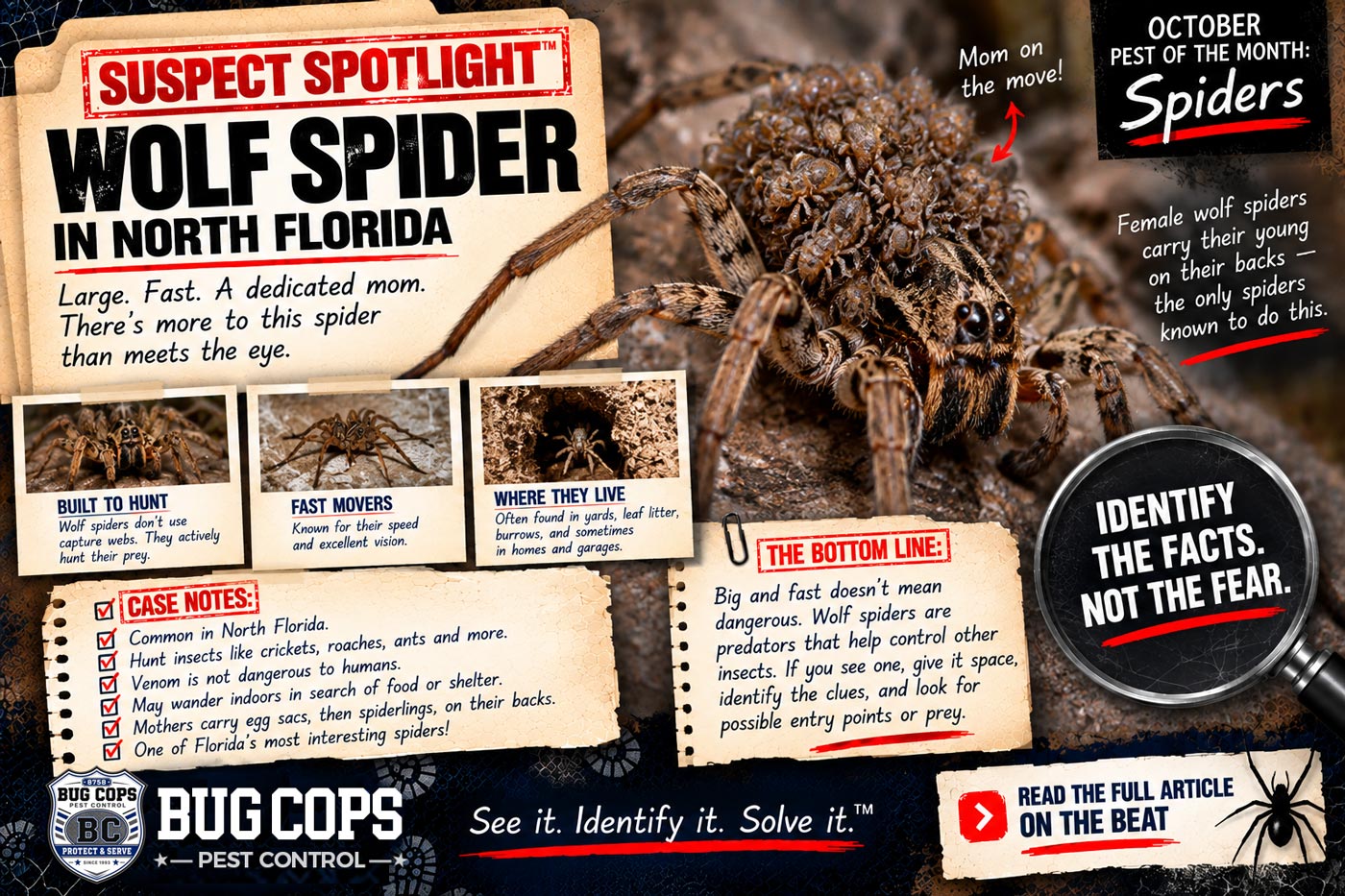
Suspect Spotlight™: Wolf Spiders in North Florida
Wolf spiders in North Florida are fast-moving, long-legged hunters that are often mistaken for more dangerous spiders. These ground-hunting spiders are found throughout the region, where they help control insect populations. Although their size and speed can be startling, their behavior tells a more interesting story than their appearance alone.
In this edition of Suspect Spotlight™, Bug Cops takes a closer look at wolf spiders, how they hunt, where homeowners may encounter them, and the clues that help distinguish them from other spiders. Understanding the suspect is the first step toward deciding whether action is needed.
The Suspect Profile: Wolf Spiders in North Florida
Wolf spiders belong to the family Lycosidae, a group of active hunters that rely on movement and keen eyesight rather than prey-catching webs. North Florida is home to several wolf spider species, which vary in size, coloring, and preferred habitat. Despite their differences, these spiders share several identifying characteristics and behaviors.
According to UF/IFAS Extension, wolf spiders are active hunters that do not rely on webs to capture prey. Their distinctive eye arrangement and maternal care provide useful clues for identification.
Evidence Board: What Makes Wolf Spiders Different?
Wolf spiders share certain features with other ground-dwelling spiders, so identification requires more than judging size or color. Two useful clues are their distinctive eye arrangement and the way females carry their egg sacs attached to the rear of their bodies.
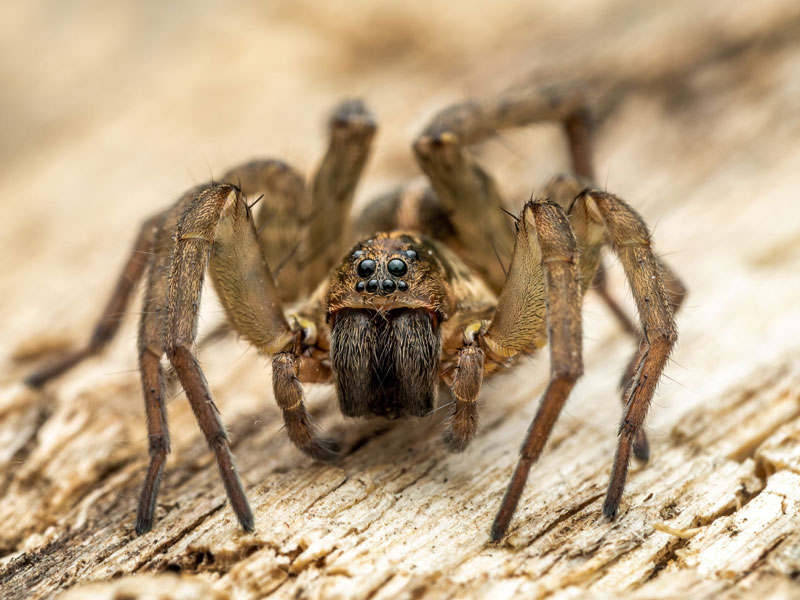
Wolf Spider Eye Arrangement
Wolf spiders have eight eyes arranged in three rows. Their two prominent middle-row eyes are especially useful identification clues.
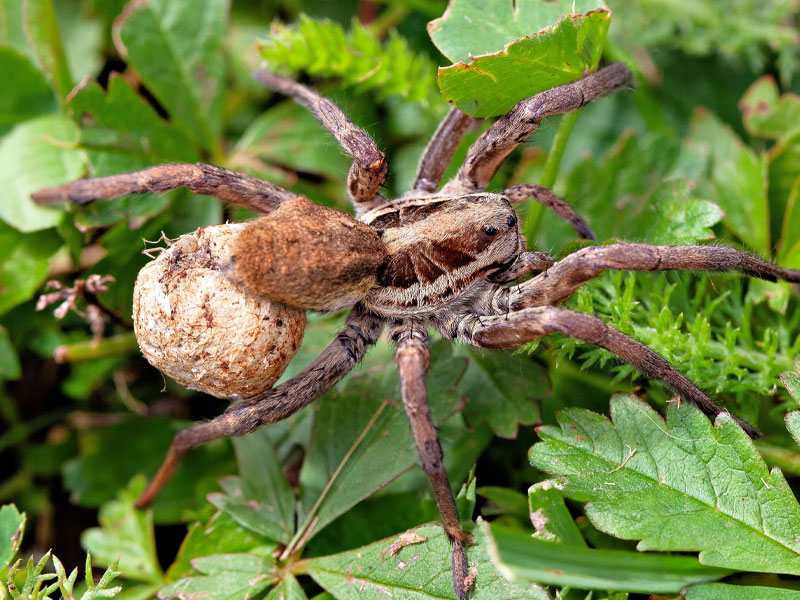
Female Wolf Spider Carrying an Egg Sac
Female wolf spiders carry their silk egg sacs attached to spinnerets at the rear of their abdomens.

Identification Note: Wolf spiders are sometimes mistaken for other large, brown spiders. Size and color alone are not reliable identification features. Their distinctive eye arrangement provides an important clue. Female wolf spiders also carry silk egg sacs attached to their spinnerets and, after hatching, carry their spiderlings on their backs. If you’re unsure which spider you’ve found, a clear photograph can help with identification.
Why Wolf Spiders Appear Around North Florida Homes
Wolf spiders are commonly found in yards, gardens, landscaped areas, and other outdoor spaces throughout North Florida. Unlike spiders that rely on webs to capture prey, wolf spiders actively hunt insects and other small creatures. Mulch beds, leaf litter, grass, and areas around landscaping provide shelter and hunting opportunities.
Although wolf spiders generally live outdoors, they sometimes wander inside homes through gaps around doors, windows, and other openings. Homeowners may notice one moving quickly across a garage floor, along a baseboard, or through a room.
Seeing a wolf spider indoors does not automatically mean there is an infestation. Often, it is simply a wandering hunter that has found its way inside.
Are Wolf Spiders Dangerous to People or Pets?
Wolf spiders may look intimidating because of their size, speed, and appearance. However, they are not considered medically significant spiders. They generally avoid people and are more likely to run away than confront someone.
A wolf spider may bite if trapped against the skin or handled. Bites can cause temporary pain, redness, and swelling. Serious reactions are uncommon, but anyone experiencing severe or unusual symptoms should seek medical attention.
Pets may occasionally investigate or attempt to catch a wolf spider. Although serious problems are uncommon, pet owners should contact their veterinarian if their animal develops concerning symptoms after a suspected bite.
How to Reduce Wolf Spider Activity Around Your Home
Because wolf spiders hunt other insects, reducing their hiding places and food sources can help discourage activity around your home. A few practical maintenance steps can also make it harder for wandering spiders to find their way indoors.
- Seal entry points: Check gaps around doors, windows, utility lines, and other openings.
- Reduce clutter: Keep stored items, firewood, and debris away from exterior walls.
- Maintain landscaping: Trim vegetation touching the home and remove excessive leaf litter near the foundation.
- Manage outdoor lighting: Reduce unnecessary nighttime lighting near entrances, which can attract insects.
- Address insect activity: Reducing insects around the home may make the area less attractive to hunting spiders.
These steps cannot eliminate every wolf spider from your property. However, they can help reduce unwanted encounters while allowing these natural insect predators to remain part of North Florida’s outdoor environment.
Case File Summary
Wolf spiders may be fast-moving and intimidating, but they are an important part of North Florida’s outdoor ecosystem. As active hunters, they help control populations of insects and other small creatures around lawns, gardens, and landscaped areas.
Finding an occasional wolf spider indoors is not necessarily a cause for alarm. However, frequent spider sightings or ongoing insect activity may indicate conditions around your home that deserve closer attention.
At Bug Cops Pest Control, we believe identifying the suspect is the first step toward finding the right solution. Understanding which spiders are present, where they are coming from, and what attracts them helps homeowners make informed pest management decisions.
And most importantly, identify the suspect before deciding what the evidence means.
Not Sure Which Spider You Found?
Visit our Spider Identification Guide to compare common spiders found around North Florida homes.
If you have a clear photograph, you can also Send Us a Pest Photo and show Bug Cops what you’re seeing.
When It’s Time to Request Backup
Bug Cops provides spider control services throughout Clay and Putnam Counties. If wolf spiders are frequently appearing indoors, we can help investigate possible entry points, surrounding insect activity, and conditions that may be attracting them.
See it. Identify it. Solve it.™
Protecting what matters most.