
Mouse Identification Guide for Clay & Putnam Counties
This Mouse Identification Guide will help you recognize house mice, identify signs of mouse activity, and distinguish mice from young rats that may look similar at first glance.
The house mouse (Mus musculus) is the primary mouse associated with homes and structures. Its small size allows it to use narrow openings and protected spaces where food, water, shelter, and nesting material are available.
House mice are considerably smaller than adult rats, but a young rat can sometimes cause confusion. Body proportions, head and foot size, tail appearance, droppings, behavior, and where activity occurs can provide useful identification clues.
Seeing a mouse isn’t always necessary to recognize activity. Small droppings, gnaw marks, shredded nesting material, scratching sounds, tracks, and evidence around food or storage areas can all indicate that mice may be present.
Not sure whether you’ve found a mouse or a young rat? Take a clear photo—or photograph the evidence you’re seeing—and send it to Bug Cops. We’ll help you take a closer look at your suspect.
What Do House Mice Look Like?
This Mouse Identification Guide focuses on features that can help distinguish house mice from young rats. Small body size, relatively large ears, delicate feet, tail appearance, and overall body proportions can help distinguish a house mouse from a young rat.
House mice typically have:
- Four feet
- A small, slender body
- A pointed muzzle
- Relatively large, prominent ears
- A long, thin tail
- Small feet compared with the body
- Continuously growing front incisors
- Mostly nocturnal activity
One useful identification clue is overall proportion. House mice have small, delicate bodies with relatively prominent ears and small feet. Young rats may be similar in overall length, but their heads and feet tend to look disproportionately large and heavy for their bodies.
Droppings and other evidence can also help. House mouse droppings are considerably smaller than rat droppings, and mice can use very small openings to enter protected spaces. Looking at the animal and the surrounding evidence together provides stronger identification.

Identification Note: Don’t rely on size alone when distinguishing a mouse from a young rat. Look at head and foot proportions, ear size, tail appearance, droppings, behavior, and where activity is occurring for stronger identification clues.
House Mouse vs. Young Rat
A house mouse and a young rat can sometimes look similar at a quick glance. Comparing body proportions, head and foot size, ears, tail appearance, and surrounding evidence can help distinguish between them.
House Mouse
Mus musculus
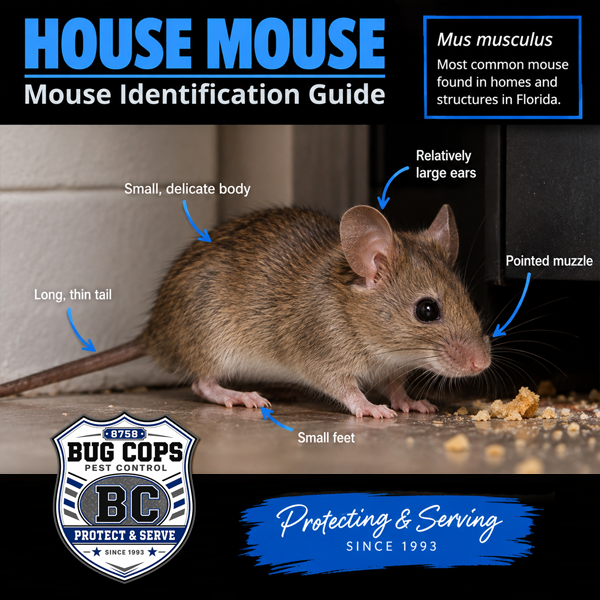
House mice have small, delicate bodies, pointed muzzles, relatively large ears, and small feet. Their tails are long and thin, and their overall proportions tend to look finer and lighter than those of a rat.
House mice can use very small openings and are commonly associated with wall voids, cabinets, storage areas, garages, attics, and other protected spaces where food and nesting material are available.
Young Rat
Rattus spp.
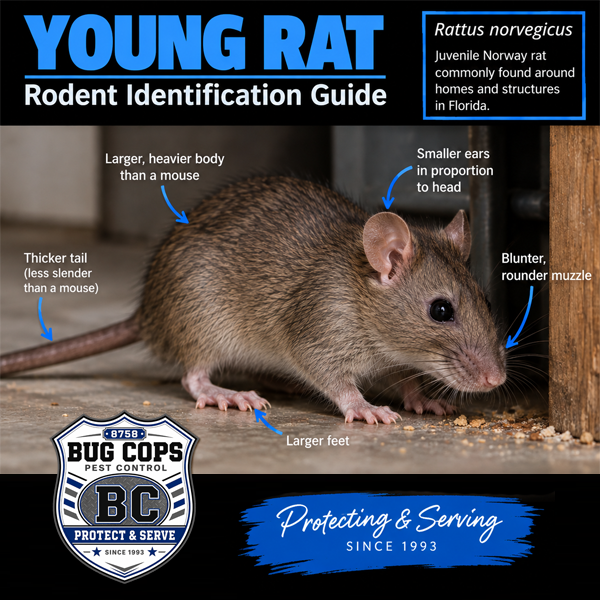
Young rats may be similar in overall size to an adult house mouse, but they generally have a heavier build with proportionally larger heads and feet. Their overall appearance tends to look more robust.
Young rats will eventually develop the characteristics of either roof rats or Norway rats, so body proportions, tail characteristics, activity location, and other evidence can help with identification.
Identification Note: Size alone can be misleading. A small rodent with delicate feet and relatively prominent ears is more consistent with a house mouse, while disproportionately large feet and a heavier head and body can point toward a young rat.
Where Are House Mice Found Around the Home?
House mice may live indoors or around structures wherever food, water, shelter, and nesting material are available. Their small size allows them to use narrow openings and protected spaces that larger rodents may not be able to access.
Kitchens & Food Storage Areas
House mice may forage around cabinets, pantries, appliances, food storage areas, and other places where crumbs or accessible food are available. Droppings or gnawing may reveal activity even when mice aren’t seen.
Wall Voids & Structural Spaces
Small openings can allow house mice to use wall voids, utility spaces, ceilings, and other protected structural areasfor travel, shelter, or nesting.
Cabinets, Closets & Storage Areas
Quiet, protected spaces containing paper, fabric, boxes, or other materials may provide house mice with shelter and potential nesting material.
Garages, Sheds & Outbuildings
Garages, sheds, storage buildings, and other protected spaces can provide mice with food, nesting material, and shelter from weather and predators.
Attics & Insulated Areas
House mice may use attics and other secluded spaces where insulation, stored materials, or other soft materialsprovide potential nesting sites.
Food, Water & Pet Areas
Pet food, bird seed, stored food, garbage, animal feed, and accessible water can support mouse activity around a home or outbuilding.
For more information about rodents found around Florida homes, visit the UF/IFAS Extension Rodents resource.
Identification Note: House mice can use very small protected spaces. Look for small droppings, gnawing, shredded nesting material, tracks, and repeated activity near food or storage areas to help identify where mice may be active.
Signs of Mouse Activity
This Mouse Identification Guide also covers evidence that may reveal activity even when house mice aren’t seen. Small droppings, gnaw marks, scratching sounds, shredded nesting material, tracks, and evidence around food or storage areas can provide clues that mice may be active
Mouse Droppings
House mouse droppings are small and may be found near food sources, cabinets, drawers, storage areas, travel routes, and nesting locations. Size, shape, location, and repeated appearance can provide useful clues. Avoid handling droppings with bare hands.
Small Gnaw Marks
House mice have continuously growing incisors and regularly gnaw on materials. Small gnaw marks may appear on food packaging, cardboard, wood, plastic, stored materials, or other surfaces.
Food Packaging Damage
Small holes, torn packaging, scattered food, or gnaw marks around stored foods, pet food, bird seed, or animal feed may indicate mouse activity.
Scratching & Movement Sounds
Light scratching, gnawing, or movement may be heard in walls, cabinets, ceilings, attics, or other protected spaces, particularly during nighttime hours.
Shredded Nesting Material
House mice may use paper, fabric, insulation, cardboard, or other soft materials for nesting. Small accumulations of shredded material in secluded areas can indicate a nearby nest.
Tracks & Travel Routes
Tiny footprints, tail marks, disturbed dust, droppings, or repeated movement along walls and edges can help reveal established mouse travel routes.
Identification Note: Don’t rely on one sign alone. Small droppings, gnawing, food damage, sounds, shredded nesting material, tracks, and where the evidence occurs are more useful when considered together.
Why Am I Seeing Mice?
House mice usually appear around a property because they have found food, water, shelter, nesting material, or accessible entry points. Their small size allows them to take advantage of resources and protected spaces that may be easy to overlook.
They’ve Found a Food Source
Crumbs, stored foods, pet food, bird seed, animal feed, garbage, and other accessible food sources can support mouse activity. Even small amounts of food can provide a reliable resource.
They’ve Found Water
Pet bowls, leaking plumbing, condensation, appliance drip areas, and other dependable moisture sources can help support mice around a home or structure.
They’ve Found Shelter
Wall voids, cabinets, closets, attics, garages, storage areas, and other protected spaces can provide mice with shelter and potential nesting locations.
Nesting Material Is Available
Paper, cardboard, fabric, insulation, and other soft materials can provide house mice with material for constructing nests in secluded spaces.
Small Entry Points Provide Access
House mice can use very small openings around doors, utility penetrations, foundations, vents, cabinets, and other structural gaps to reach protected areas.
Activity Has Become Established
Repeated evidence in the same area—such as droppings, food damage, gnawing, sounds, or nesting material—can indicate that mice are regularly using the space rather than simply passing through.
Identification Note: If mouse activity keeps returning, look beyond where the evidence appears. Food, water, shelter, nesting material, small entry points, and established travel routes can all contribute to recurring activity.
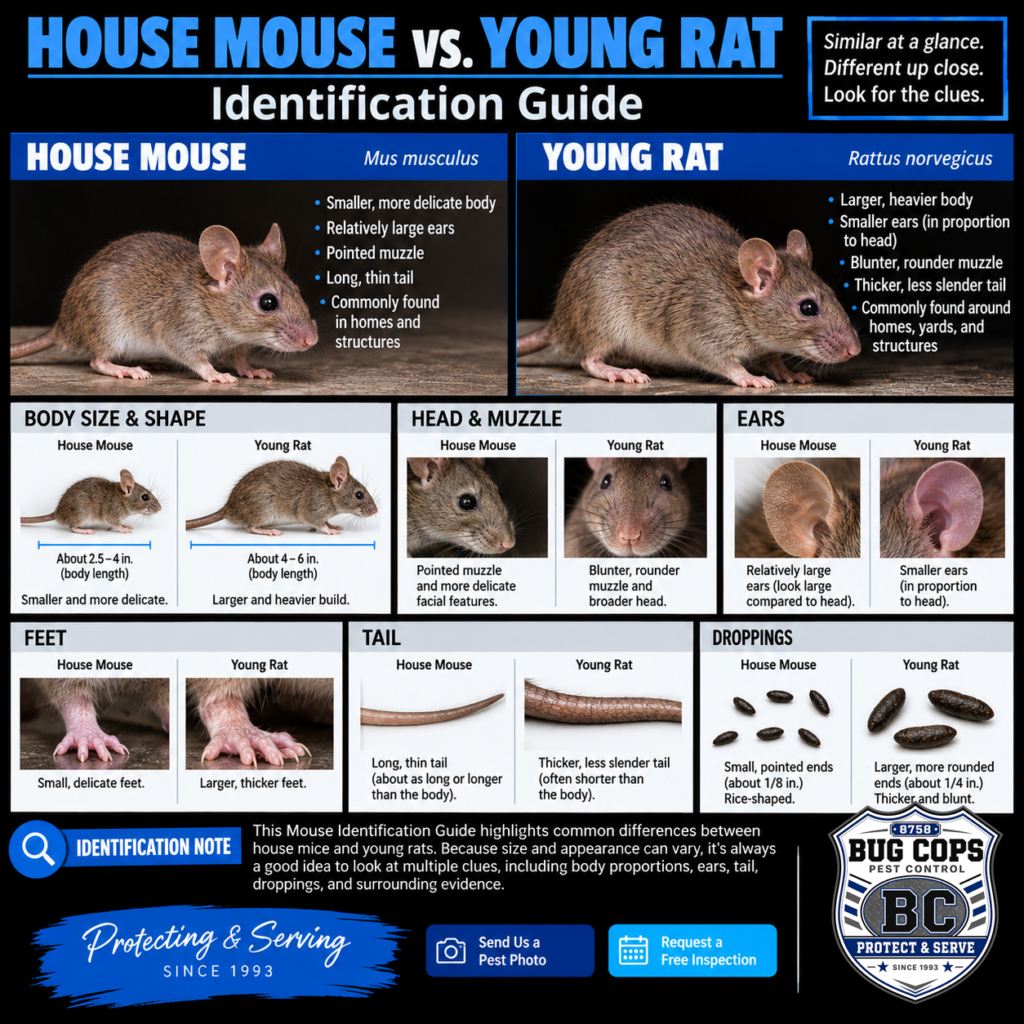
House Mouse vs. Young Rat: Identification Clues
This Mouse Identification Guide compares house mice and young rats using body build, head and foot proportions, ears, tail appearance, droppings, and overall proportions.
Body Build
House Mouse: Small, slender, delicate body.
Young Rat: Heavier, more robust body for its size.
Head & Muzzle
House Mouse: Small head with a pointed muzzle.
Young Rat: Head often appears proportionally larger and heavier.
Ears
House Mouse: Relatively large, prominent ears.
Young Rat: Ears generally appear smaller in proportion to the head.
Feet
House Mouse: Small, delicate feet proportional to the body.
Young Rat: Feet often appear disproportionately large compared with the body.
Tail Appearance
House Mouse: Long, thin tail with a finer appearance.
Young Rat: Tail generally appears thicker and more substantial.
Droppings
House Mouse: Small droppings, typically much smaller than rat droppings.
Young Rat: Droppings become larger and more characteristic of rats as the animal grows.
Identification Note: Size alone can be misleading. Look at head and foot proportions, ear size, tail appearance, droppings, and overall body build when distinguishing a house mouse from a young rat.
When Should I Be Concerned About Mouse Activity?
Seeing an occasional sign does not always reveal how much mouse activity is present. However, fresh droppings, repeated nighttime sounds, food damage, increasing evidence, nesting material, or signs of mice entering living or storage areas can warrant closer attention.
Fresh Droppings Keep Appearing
New mouse droppings repeatedly appearing after an area has been cleaned can indicate ongoing activity and an established travel or feeding area.
Nighttime Sounds Are Repeating
Light scratching, gnawing, or movement in walls, cabinets, ceilings, attics, or other protected spaces, particularly at night, can indicate mice are regularly using the area.
Food or Packaging Is Being Damaged
New holes, gnaw marks, torn packaging, or scattered food around pantries, cabinets, pet food, bird seed, or stored goods can indicate active mice.
Mice Are Entering Living Areas
Seeing mice or repeatedly finding evidence in kitchens, cabinets, closets, bedrooms, or other occupied areas can indicate established access to the interior of the home.
Nesting Material Is Appearing
Shredded paper, fabric, insulation, cardboard, or other soft materials accumulating in secluded areas can indicate that mice are nesting nearby.
Evidence Keeps Returning
When droppings, food damage, gnawing, sounds, tracks, or nesting material continue returning to the same area, the source of activity may not have been addressed.
Not sure whether the evidence you’re seeing is from a mouse or another rodent? Bug Cops Pest Control offers free home inspections to help identify what you’re dealing with and determine the appropriate next step.

Inspection Note: Recurring mouse activity can provide important clues. We look at where evidence appears, where mice may be traveling, what food or nesting resources are available, and how they may be entering or using the structure.
Mouse Identification Guide FAQs
House mice have small, delicate bodies, pointed muzzles, relatively large ears, and small feet. Young rats tend to have heavier bodies with proportionally larger heads and feet. Size alone can be misleading, so several features should be considered together.
The house mouse (Mus musculus) is the mouse most commonly associated with homes and structures. Its small size allows it to use narrow openings and protected spaces where food, shelter, and nesting material are available.
House mice are primarily nocturnal. Light scratching, gnawing, or movement may be heard in walls, cabinets, ceilings, attics, or other protected spaces when the home is quiet.
Common evidence includes small droppings, gnaw marks, damaged food packaging, scratching sounds, shredded nesting material, tracks, and repeated activity around food or storage areas.
Droppings confirm that mouse activity has occurred, but their presence alone doesn’t establish when it happened. Repeatedly finding new droppings or other fresh evidence provides a stronger indication of current activity.
Not Sure If You’ve Found a House Mouse?
This Mouse Identification Guide can help when house mice are confused with young rats. Body proportions, head and foot size, ear size, tail appearance, droppings, and surrounding evidence can all provide useful identification clues.
Don’t guess. If you’ve found a mouse or rodent evidence you don’t recognize, take a clear photo and send it to Bug Cops. We’ll help you take a closer look at your suspect.
Protecting & Serving Clay and Putnam Counties Since 1993
If mouse activity keeps returning around your home or property, Bug Cops Pest Control can help identify the rodent, evaluate where activity may be originating, and determine how mice may be entering or using the structure.
Free home inspections are available if you’d like us to take a closer look.