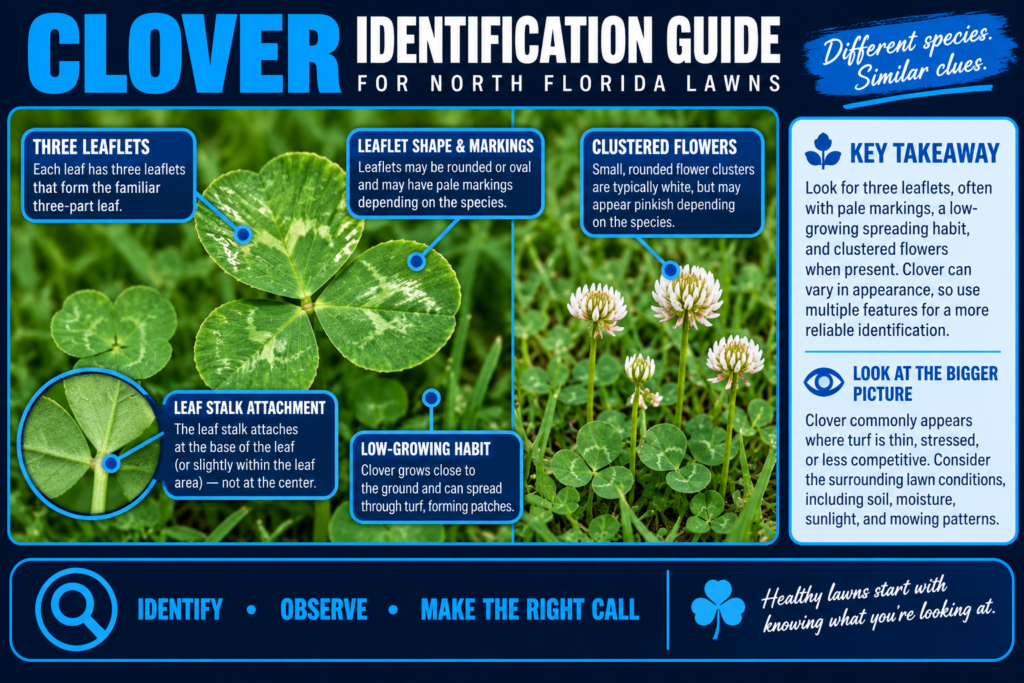
Clover Identification Guide for North Florida Lawns
This Clover Identification Guide will help North Florida homeowners recognize clover, understand where it commonly grows in lawns, and identify characteristics that help distinguish it from similar broadleaf weeds.
Clover is a low-growing broadleaf weed recognized by its distinctive three-part leaves. It can spread through turf and form patches where growing conditions allow it to compete with the surrounding grass.
Finding clover is only part of the picture. Where it is growing, how dense the surrounding turf is, soil conditions, moisture, sunlight, and other site conditions can provide useful clues about why it became established.
Small Weed. Useful Clues.
What Does Clover Look Like?
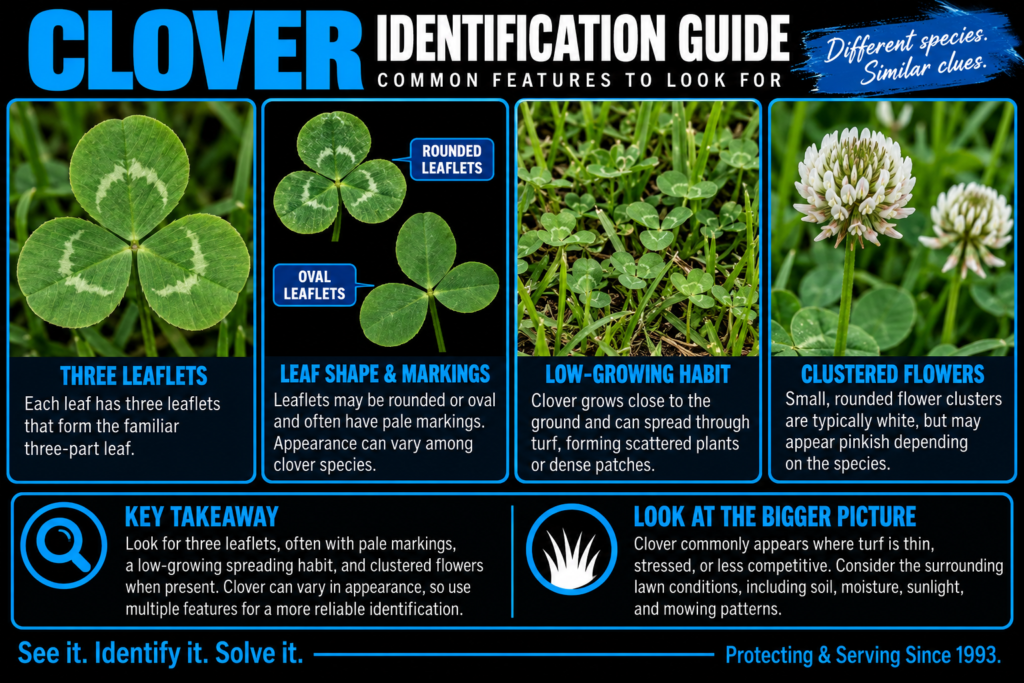
Clover is best recognized by its three leaflets, which together form the familiar three-part leaf. Depending on the species, the leaflets may be rounded or oval and may show pale markings across their surface.
Clover grows close to the ground and can spread into patches within the turf. Small clustered flowers may also provide an identification clue when the plant is blooming.
What Might Clover Be Telling You?
Clover doesn’t automatically mean something is wrong with the lawn. It can become established where turf is thin, stressed, or less competitive, leaving room for low-growing broadleaf weeds to spread.
Look at the clover together with the surrounding lawn. Its location, density, turf coverage, soil conditions, moisture, sunlight, and mowing patterns can provide useful clues about why it is growing there.
Useful things to notice include:
• Thin or open areas in the turf
• Whether clover occurs as scattered plants or spreading patches
• Sunlight and moisture conditions
• The overall health and density of the surrounding grass
Bug Cops provides Lawn and Ornamental Care Services throughout Clay and Putnam Counties, with programs built around the conditions we encounter in our local lawns and landscapes.
Where Should You Look?
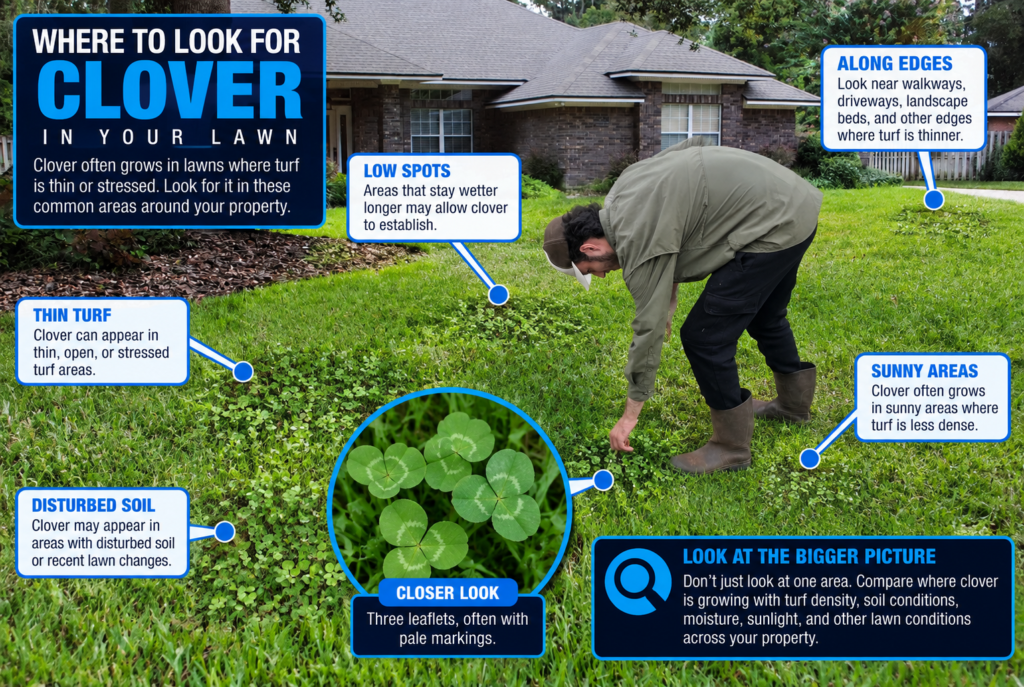
Clover may appear in lawns, open turf, landscape edges, and other areas where low-growing plants have room to spread.
Look closely where turf is thin or where patches of three-part leaves are spreading between grass blades.
Don’t judge the lawn from the clover alone. Compare where it is growing with nearby turf density, soil conditions, moisture, sunlight, and other conditions across the property.

Identification Note: Look for Three Leaflets Together. Look for the distinctive three-part leaves when identifying clover but leaf shape and markings can vary among clover species. Look at the three leaflets together with the plant’s low-growing habit, spreading pattern, and flowers when present rather than relying on one feature alone.
Not sure this is clover? Compare it with other common broadleaf weeds in our Broadleaf Weed Identification Guide. For additional university-based information about identifying and managing weeds in Florida lawns, visit the UF/IFAS Weed Management Guide for Florida Lawns.
Clover Identification Guide FAQs
Clover can become established in lawns where turf is thin, stressed, or less competitive. It may occur as scattered plants or spread into patches where growing conditions give it room to establish.
The distinctive three-part leaves provide one of the best clues for recognizing clover. However, leaf shape and markings can vary among clover species. Small clustered flowers can provide another clue when the plant is blooming.
Yes. Leaf shape, markings, flower color, and growth habit can vary among clover species. For that reason, looking at several characteristics together provides a more reliable identification than relying on one feature alone.
Not necessarily. In fact, clover can grow under a variety of lawn conditions, so its presence alone should not be used to diagnose a soil problem. Turf density, soil conditions, moisture, sunlight, mowing practices, and other site factors should also be considered.
Yes. Clover is one of the common broadleaf weeds covered by our Lawn and Ornamental Care program. Before recommending an approach, we look at the weed and surrounding lawn conditions.
Not Sure What’s Growing in Your Lawn?
Weeds can look similar, especially when they’re young or growing down within the turf. Take a clear photo of the entire plant, along with close-ups of the leaves, stems, flowers, or seed structures if present, and send it to Bug Cops. We’ll help you narrow down what you’re seeing.
Protecting & Serving Clay and Putnam Counties Since 1993
Clover and other broadleaf weeds may keep appearing in your lawn. When that happens, Bug Cops can inspect the turf and look at conditions that may be contributing to weed pressure. We can then recommend the appropriate next step.