Broadleaf Weed Identification Guide for North Florida Lawns
This Broadleaf Weed Identification Guide will help North Florida homeowners recognize common broadleaf weeds found in lawns and understand some of the conditions that may favor their growth. Finding a weed can tell us more than simply what plant is growing in the turf. Moisture, soil conditions, turf density, mowing practices, sunlight, and other environmental factors can influence which weeds become established.
What Might This Weed Be Telling You?
Weeds don’t necessarily cause poor lawn conditions—they often take advantage of them. Thin turf, bare areas, excessive moisture, dry soil, compaction, and other stresses can create opportunities for certain weeds to establish. Looking at where a weed is growing and what is happening around it can therefore provide useful clues about the lawn itself. UF/IFAS describes this principle simply: weeds can help indicate underlying soil or site conditions.
Meet the Broadleaf Weeds
Carolina Geranium
A cool-season broadleaf weed that can appear in lawns during the cooler months. Its divided leaves and small pinkish-purple flowers can help distinguish it from surrounding turf.
Dollarweed
A round-leaved broadleaf weed commonly associated with wet or poorly drained areas. Persistent dollarweed can be an important clue that soil moisture or irrigation conditions deserve a closer look.
Asiatic Pennywort
A low-growing broadleaf weed that can occur in moist areas and spread through the turf. Its rounded leaves can resemble dollarweed, making close identification important.
Clover
A low-growing broadleaf weed with distinctive three-part leaves. Clover can become established where turf is thin or stressed, and some species can tolerate conditions where the surrounding grass is less competitive.
Dandelion
A broadleaf weed recognized by its deeply toothed leaves, yellow flowers, and seed heads. Its deep taproot allows established plants to persist even when above-ground growth is removed.
About Our Weed Program: Bug Cops Pest Control provides targeted management of common broadleaf weeds covered by our Lawn and Ornamental Care program. Our program does not include control of grassy weeds or sedges.
Weeds Can Be Clues to Lawn Conditions
Finding a weed doesn’t automatically tell us exactly what’s wrong with a lawn, but where it is growing and the conditions around it can provide useful clues. Some weeds are better adapted to wet soil, dry areas, compacted ground, thin turf, or other conditions that make it easier for them to become established. Looking at the weed along with the surrounding turf helps build a better picture of what’s happening in the lawn.
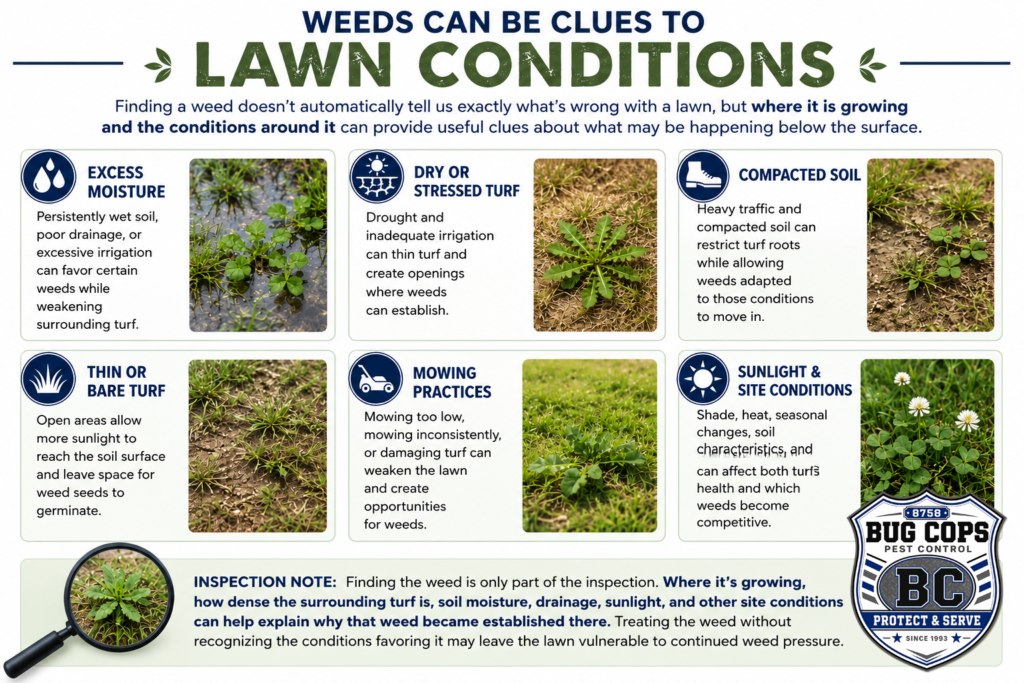

Inspection Note: Finding the weed is only part of the inspection. Where it’s growing, how dense the surrounding turf is, soil moisture, drainage, sunlight, and other site conditions can help explain why that weed became established there. Treating the weed without recognizing the conditions favoring it may leave the lawn vulnerable to continued weed pressure.
Explore the individual guides: Carolina Geranium Identification Guide · Dollarweed Identification Guide · Asiatic Pennywort Identification Guide · Clover Identification Guide · Dandelion Identification Guide
Similar Weeds Can Need a Closer Look
Broadleaf weeds can look surprisingly similar at first glance, especially when they are growing down within the turf. Leaf shape, growth habit, flowers, stems, and where the weed is growing can all provide identification clues. Correct identification matters because two weeds that look alike may respond differently to lawn conditions and management.
Look at the Leaves
Shape, edges, arrangement, and where the leaf attaches to the stem can provide some of the first identification clues.
Look at How It Grows
Some weeds grow upright, while others creep or spread along the ground. Growth pattern can help separate similar-looking plants.
Look at Where It’s Growing
Wet areas, thin turf, compacted soil, shade, full sun, and other site conditions can provide additional clues about both the weed and the lawn around it.
Inspection Note: Don’t Identify a Weed by One Feature Alone. A round leaf, small flower, or low-growing habit may narrow down the possibilities, but it may not identify the weed by itself. Looking at several characteristics together—and considering the conditions where the plant is growing—provides a much better picture.
Broadleaf Weed Identification Guide FAQs
Broadleaf weeds often become established where conditions give them an opportunity to compete with the turf. Thin grass, bare areas, excessive moisture, drought stress, compacted soil, mowing practices, and other site conditions can all influence weed growth. Identifying the weed and looking at the surrounding lawn can help provide clues about why it is there.
Sometimes. Certain weeds are better adapted to particular conditions, such as persistently wet soil or thin, stressed turf. A weed should not be used as the only diagnosis, but where it is growing and the conditions around it can provide useful information during an inspection.
Broadleaf weeds can look similar, especially when they are young or growing down within the turf. Leaf shape, growth habit, flowers, stems, and site conditions can help distinguish one weed from another. Correct identification helps determine what may be happening in the lawn and what management approach is appropriate.
No. Bug Cops’ Lawn and Ornamental Care program provides management of common broadleaf weeds covered by our program. Our program does not include control of grassy weeds or sedges.
Take clear photos of the entire plant and close-ups of the leaves, stems, and flowers if present. You can send Bug Cops a photo for help identifying what you’re seeing, or request an inspection if the lawn has broader problems that need a closer look.
For additional university-based information about identifying and managing weeds in Florida lawns, visit the UF/IFAS Extension lawn weed resources.
Not Sure What’s Growing in Your Lawn?
Weeds can provide clues about what’s happening in a lawn, but identifying the plant is only part of the picture. Bug Cops looks at the weed itself, turf condition, soil moisture, drainage, sunlight, and other site conditions to help determine what may be contributing to the problem.
Protecting & Serving Clay and Putnam Counties Since 1993
The right lawn care starts with identifying the problem correctly. Don’t guess. Bug Cops offers free Lawn and Ornamental inspections if you’d like us to take a closer look.